


Get ready to pass the F5CAB3 Exam right now using our F5-CA Exam Package
A fully updated 2026 F5CAB3 Exam Dumps exam guide from training expert PracticeTorrent
NEW QUESTION # 31
What is the status of a pool member when manual resume is enabled and a health check first fails and then passes?
- A. Offline (Enabled)
- B. Available (Disabled)
- C. Offline (Disabled)
- D. Available (Enabled)
Answer: C
Explanation:
With manual resume enabled, BIG-IP does not automatically return a pool member to service after recovery. The member remains offline until manually re-enabled.
NEW QUESTION # 32
In a pool there are 2 pool members out of the 5 members that are older servers. The number of connections these can handle is less than the other 3 pool members. Which load balancing method would allow more traffic to be directed to the newer servers? (Choose one answer)
- A. Weighted Least Connections (member)
- B. Round Robin
- C. Global Availability
- D. Least Connections (member)
Answer: A
Explanation:
When a pool contains servers with heterogeneous hardware capabilities (differing CPU, RAM, or connection limits), a static load balancing method like Round Robin is ineffective because it distributes requests equally, regardless of the server's capacity. To optimize traffic distribution for newer, more powerful servers, a dynamic or weighted method is required.
* Weighted Least Connections (member): This is the ideal method for this scenario. It combines two factors:
* Least Connections: It first checks the current active connection count to ensure traffic goes to the least busy server.
* Weight (Ratio): It allows the administrator to assign a "Ratio" value to each pool member. Newer servers can be assigned a higher ratio (e.g., 3) while older servers are assigned a lower ratio (e.g.,
1). The BIG-IP system uses these weights to disproportionately favor the newer servers even when connection counts are similar.
* Why other options are incorrect:
* Global Availability: This is primarily a GSLB (Global Server Load Balancing) or specific LTM priority group concept where traffic is sent to the first available member in a list until it fails, then moves to the next. It does not load balance based on capacity.
* Round Robin: This passes each new connection request to the next server in line, treating the old and new servers exactly the same.
* Least Connections (member): While this sends traffic to the server with the fewest active connections, it assumes all servers are equal. If an old server and a new server both have 10 connections, they are treated as equally capable of taking the 11th, which is not true in this scenario.
NEW QUESTION # 33
Which of the following has iApp configured objects?
- A. ltm virtual /Common/test_vs {creation-time 2023-09-01:12:28:27destination /Common/10.176.21.11:
443disabledip-protocol tcplast-modified-time 2023-09-01:12:29:40mask 255.255.255.255profiles {
/Common/fastL4 {}}serverssl-use-sni disabledsource 0.0.0.0/0translate-address enabledtranslate-port enabled} - B. ltm virtual /Common/app1_vs {creation-time 2020-02-07:09:47:12description https://app1.apmsupport.
localdestination /Common/10.155.47.160:443ip-protocol tcplast-modified-time 2024-05-15:09:57:
19mask 255.255.255.255pool /Common/https_lamp_poolprofiles {/Common/apm_support {context clientside}/Common/f5-tcp-progressive {}/Common/http {}/Common/multi_domain_ap {}/Common
/oneconnect {}/Common/rba {}/Common/serverssl {context serverside}/Common/websso {}}serverssl- use-sni disabledsource 0.0.0.0/0source-address-translation {type automap}translate-address enabledtranslate-port enabled} - C. ltm virtual /Common/vmware_test.app/vmware_test_proxy_https {app-service /Common/vmware_test.
app/vmware_testcreation-time 2024-04-12:08:49:12destination /Common/10.155.47.199:443ip- protocol tcplast-modified-time 2024-04-12:08:49:12mask 255.255.255.255profiles {/Common/ppp {}
/Common/rba {}/Common/vdi {}/Common/vmware_test.app/vmware_test {}/Common/vmware_test.
app/vmware_test_client_ssl {context clientside}/Common/vmware_test.app/vmware_test_connect
{context clientside}/Common/vmware_test.app/vmware_test_http {}/Common/vmware_test.app
/vmware_test_lan_optimized_tcp {context serverside}/Common/vmware_test.app
/vmware_test_server_ssl {context serverside}/Common/vmware_test.app
/vmware_test_wan_optimized_tcp {context clientside}/Common/websso {}}serverssl-use-sni disabledsource 0.0.0.0/0source-address-translation {type automap}translate-address enabledtranslate- port enabled} - D. ltm virtual /Common/app2_vs {creation-time 2020-02-07:09:48:01description https://app2.apmsupport.
localdestination /Common/10.155.47.161:443ip-protocol tcplast-modified-time 2024-05-13:06:02:
40mask 255.255.255.255pool /Common/https_lamp_poolprofiles {/Common/apm_support {context clientside}/Common/f5-tcp-progressive {}/Common/http {}/Common/multi_domain_ap {}/Common
/rba {}/Common/serverssl {context serverside}/Common/websso {}}serverssl-use-sni disabledsource
0.0.0.0/0source-address-translation {type automap}translate-address enabledtranslate-port enabled}
Answer: C
Explanation:
An F5 iApp is a template-driven system used to deploy complex applications by grouping all necessary BIG- IP objects (Virtual Servers, Pools, Profiles) into a single management entity. Objects created by an iApp are distinguished by their naming convention and metadata. In the provided exhibit, the Virtual Server configuration in Option A is clearly identified as an iApp-managed object through two primary indicators.
First, the object resides within a sub-directory or partition ending in .app (/Common/vmware_test.app/).
Second, the configuration explicitly includes the attribute app-service /Common/vmware_test.app
/vmware_test, which serves as the system's internal pointer linking the LTM object back to the parent iApp Application Service. Furthermore, several profiles associated with this virtual server also reside within the same .app container, such as /Common/vmware_test.app/vmware_test_http.
In contrast, Options B, C, and D represent standard, manually created Virtual Servers. While they may have complex configurations (such as the APM profiles in app2_vs and app1_vs), they lack the folder-based naming hierarchy and the app-service metadata attribute that denotes iApp ownership. Standard objects like app1_vs are managed individually, whereas the objects within vmware_test.app are typically protected by
"Strict Updates." This means their configuration is controlled by the iApp's template logic; any manual attempt to modify these specific parameters directly via the Virtual Server menu would result in an error message stating the service must be updated via the application management interface. Identifying these objects is a critical procedural step for administrators to determine whether a configuration should be edited through the standard LTM menus or through the iApp's "Reconfigure" tab to ensure consistency and prevent manual changes from being overwritten by the template.
NEW QUESTION # 34
A BIG-IP Administrator uses backend servers to host multiple services per server. There are multiple virtual servers and pools defined, referencing the same backend servers.
Which load balancing algorithm is most appropriate to have an equal number of connections on each backend server? (Choose one answer)
- A. Predictive (member)
- B. Least Connections (node)
- C. Predictive (node)
- D. Least Connections (member)
Answer: B
Explanation:
In this scenario, each backend node (server) hosts multiple services and is referenced by multiple pools and virtual servers. The goal is to ensure an equal number of total connections per backend server, regardless of how many pool members (services/ports) exist on that server.
According to the BIG-IP Administration: Data Plane Configuration documentation:
Least Connections (node) tracks the total number of active connections to a node across all pool members and services.
This algorithm ensures load distribution is balanced at the server level, not just at the individual service (member) level.
It is specifically recommended when:
Multiple pool members exist on the same backend server
Multiple virtual servers reference the same backend servers
Why the other options are incorrect:
B . Predictive (member)
Predictive algorithms are advanced and traffic-pattern based, but they operate at the member level and do not guarantee equal connections per server.
C . Least Connections (member)
This balances connections per pool member, which can overload a server hosting multiple members while still appearing "balanced" per member.
D . Predictive (node)
Although node-aware, predictive algorithms are less deterministic and not the best choice when strict equality of connections is required.
Correct Resolution:
Using Least Connections (node) ensures that each backend server carries an equal connection load across all services and pools.
NEW QUESTION # 35
The BIG-IP Administrator is investigating whether better TCP performance is possible for a virtual server.
Which built-in profile should be tried first? (Choose one answer)
- A. f5-tcp-mobile
- B. No option
- C. f5-tcp-legacy
- D. f5-tcp-progressive
Answer: D
Explanation:
BIG-IP provides several built-in TCP profiles optimized for different traffic patterns and network conditions. When attempting to improve general TCP performance, the recommended starting point is f5-tcp-progressive.
According to the BIG-IP Administration: Data Plane Configuration documentation:
f5-tcp-progressive is designed as a balanced, general-purpose TCP optimization profile.
It dynamically adjusts TCP behavior to improve throughput and latency for most enterprise applications.
It is the recommended first-choice profile when tuning TCP performance before moving to more specialized profiles.
Why the other options are incorrect:
A . f5-tcp-legacy
This profile exists for backward compatibility and does not include modern TCP optimizations.
C . f5-tcp-mobile
This profile is optimized specifically for high-latency, lossy mobile networks and is not suitable for general-purpose environments.
D . No option
BIG-IP explicitly provides built-in TCP profiles for performance tuning; using none would forgo optimization opportunities.
Correct Resolution:
The administrator should first apply f5-tcp-progressive to evaluate potential TCP performance improvements before considering more specialized profiles.
NEW QUESTION # 36
Refer to the exhibit.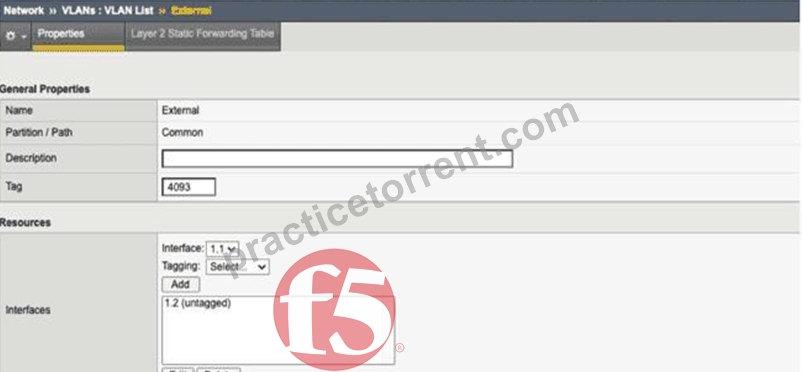
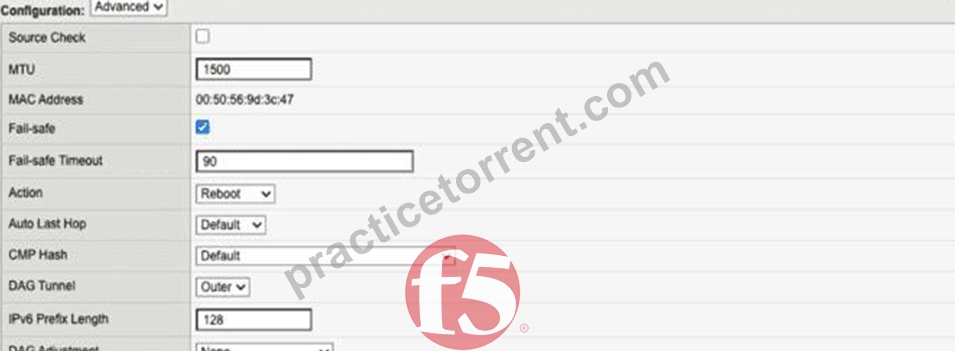
A BIG-IP Administrator configures a new VLAN on an HA pair of devices that does NOT yet have any traffic. This action causes the assigned traffic group to fail over to the standby device. Which VLAN setting should be changed to prevent this issue?
- A. Fail-safe
- B. Source Check
- C. Auto Last Hop
- D. Customer Tag
Answer: A
Explanation:
The exhibit shows the advanced configuration of a VLAN where the Fail-safe option is checked. VLAN Fail- safe is a high-availability feature used to monitor network connectivity on a specific VLAN. When enabled, the BIG-IP system monitors the VLAN for network traffic. If the system does not detect any "useful" traffic on the VLAN within the specified Fail-safe Timeout (which is 90 seconds in the exhibit), it attempts to generate traffic by pinging the default gateway or other devices. If it still detects no traffic, the BIG-IP concludes that the VLAN is unreachable or the network interface has failed, and it triggers a "Fail-safe Action"-in this case, "Reboot" or a failover to the peer device in the HA group.
Because the administrator has just created a new VLAN that "does NOT yet have any traffic," the Fail-safe mechanism triggers immediately after the 90-second timeout period. Since no devices are yet communicating on this VLAN, the BIG-IP incorrectly assumes there is a hardware or cabling failure and forces a failover to ensure the standby device (which might have better connectivity) takes over. To prevent this unwanted failover, the administrator should uncheck the Fail-safe box for that specific VLAN until the VLAN is fully populated with active nodes and regular traffic. Once the application is live and traffic is flowing, Fail-safe can be re-enabled to provide an additional layer of redundancy. Auto Last Hop (Option A) and Source Check (Option B) are routing and security features that do not trigger HA failover events.
NEW QUESTION # 37
A Virtual Server uses an iRule to send traffic to pool members depending on the URI. The BIG-IP Administrator needs to modify the pool member in the iRule.
Which event declaration does the BIG-IP Administrator need to change to accomplish this?
- A. CLIENT_ACCEPTED
- B. HTTP_REQUEST
- C. HTTP_RESPONSE
- D. SERVER_CONNECTED
Answer: B
Explanation:
URI-based traffic steering requires inspection of the HTTP request. BIG-IP processes HTTP headers and URIs in the HTTP_REQUEST event. Pool member selection based on URI must occur before the request is sent to the server, making HTTP_REQUEST the correct event.
NEW QUESTION # 38
A BIG-IP Administrator uses backend servers to host multiple services per server. There are multiple virtual servers and pools defined, referencing the same backend servers.
Which load balancing algorithm is most appropriate to have an equal number of connections on each backend server? (Choose one answer)
- A. Predictive (member)
- B. Least Connections (node)
- C. Predictive (node)
- D. Least Connections (member)
Answer: B
Explanation:
In this scenario, each backend node (server) hosts multiple services and is referenced by multiple pools and virtual servers. The goal is to ensure an equal number of total connections per backend server, regardless of how many pool members (services/ports) exist on that server.
According to the BIG-IP Administration: Data Plane Configuration documentation:
* Least Connections (node) tracks the total number of active connections to a node across all pool members and services.
* This algorithm ensures load distribution is balanced at the server level, not just at the individual service (member) level.
* It is specifically recommended when:
* Multiple pool members exist on the same backend server
* Multiple virtual servers reference the same backend servers
Why the other options are incorrect:
* B. Predictive (member)Predictive algorithms are advanced and traffic-pattern based, but they operate at the member level and do not guarantee equal connections per server.
* C. Least Connections (member)This balances connections per pool member, which can overload a server hosting multiple members while still appearing "balanced" per member.
* D. Predictive (node)Although node-aware, predictive algorithms are less deterministic and not the best choice when strict equality of connections is required.
Correct Resolution:
Using Least Connections (node) ensures that each backend server carries an equal connection load across all services and pools.
NEW QUESTION # 39
A Standard Virtual Server for a web application is configured with SNAT Automap. The original client IP must be known by backend servers.
What should the BIG-IP Administrator configure?
- A. Performance (HTTP) Virtual Server
- B. HTTP profile with X-Forwarded-For
- C. HTTP Transparent profile
- D. SNAT pool using client IP
Answer: B
Explanation:
X-Forwarded-For inserts the original client IP into HTTP headers while SNAT is enabled.
NEW QUESTION # 40
A Standard Virtual Server for a web application is configured with Automap for Source Address Translation. The original client IP must be known by backend servers.
What should the BIG-IP Administrator configure?
- A. Performance (HTTP) Virtual Server
- B. HTTP Transparent profile
- C. SNAT pool using client IP
- D. HTTP profile to insert X-Forwarded-For
Answer: D
Explanation:
The X-Forwarded-For header preserves the original client IP when SNAT is enabled.
NEW QUESTION # 41
A BIG-IP Administrator needs to apply persistence to a virtual server that is configured as a Performance (Layer 4) virtual server that allows access to a secure (TLS) e-commerce website.
What type of persistence profile can be used? (Choose one answer)
- A. Source Address Affinity
- B. Cookie persistence
- C. Microsoft RDP persistence
- D. Host persistence
Answer: A
Explanation:
A Performance (Layer 4) virtual server does not inspect or process application-layer data such as HTTP headers or cookies. Therefore, only Layer 4-compatible persistence methods can be used.
According to the BIG-IP Administration: Data Plane Configuration documentation:
Source Address Affinity persistence operates at Layer 4 and uses the client IP address to maintain session persistence.
It is fully compatible with Performance (Layer 4) virtual servers.
It works regardless of encryption, making it suitable for TLS-secured applications.
Why the other options are incorrect:
B . Cookie persistence
Requires an HTTP profile and Layer 7 inspection, which is not supported on Performance virtual servers.
C . Microsoft RDP persistence
Is protocol-specific and not applicable to web-based TLS traffic.
D . Host persistence
Requires HTTP host header inspection, which is not available at Layer 4.
Correct Resolution:
Source Address Affinity persistence is the appropriate choice for maintaining persistence on a Performance (Layer 4) virtual server handling TLS traffic.
Below is Batch 1 (Questions 1-10) extracted only from your uploaded document that are directly related to BIG-IP Administration: Data Plane Configuration topics (Virtual Servers, Pools, Load Balancing, Monitors, Persistence, SNAT, Profiles).
I have excluded system-only, licensing, support, hardware, HA management-only, and admin UI questions that are not Data Plane-focused.
Source: Your uploaded TMOS Administration v2.0 document
✅ BATCH 1 (10 Questions)
NEW QUESTION # 42
A web server administrator informs the BIG-IP Administrator that web servers currently load-balanced require encrypted traffic. Starting next month, the web server administrator will offload SSL. Starting next month, the BIG-IP device will terminate SSL to reduce web server load. The BIG-IP device is already using Client SSL, Client port, and iRules on HTTP traffic. What actions should the BIG-IP Administrator take to achieve the desired configuration? (Choose one answer)
- A. Remove the client SSL profile and change the Virtual Server to accept HTTP traffic
- B. Remove the server SSL profile and change the Virtual Server to accept HTTP traffic
- C. Remove the server SSL profile and configure the pool members to use HTTP
- D. Remove the client SSL profile and configure the pool members to use HTTP
Answer: C
Explanation:
To solve this requirement, we must distinguish between the two "legs" of an SSL connection in a BIG-IP environment: Client-side and Server-side.
Current State (SSL Bridging): The administrator states the servers currently require encrypted traffic. This means the BIG-IP is likely performing "SSL Bridging." In this setup, a Client SSL profile terminates encryption from the user, and a Server SSL profile re-encrypts the traffic before sending it to the back-end servers.
Target State (SSL Offloading): The requirement is to "offload SSL" to reduce web server load. This means the BIG-IP will continue to handle the encryption for the users (keeping the Client SSL profile) but will communicate with the back-end servers using unencrypted HTTP.
Why Option A is correct:
Remove the Server SSL profile: By removing this profile, the BIG-IP stops attempting to initiate an SSL/TLS handshake with the pool members.
Configure Pool Members to use HTTP: The service port for the pool members must be changed (typically from port 443 to port 80) so that the BIG-IP sends standard HTTP traffic to the servers.
Why other options are incorrect:
B & D: These suggest removing the Client SSL profile. If you remove this, the users can no longer connect via HTTPS, which violates the requirement for encrypted communication between the users and the BIG-IP.
C: Changing the Virtual Server to accept HTTP traffic would mean the user-to-BIG-IP connection is no longer encrypted, which is the opposite of SSL termination/offloading.
NEW QUESTION # 43
A BIG-IP Administrator needs to configure health monitors for a pool containing HTTP, HTTPS, FTP, and SSH services.
Which configuration ensures accurate member status?
- A. ICMP + TCP with all
- B. HTTP and HTTPS only
- C. All monitors with Availability Requirement = at least one
- D. All monitors with Availability Requirement = all
Answer: C
Explanation:
Using "at least one" ensures each member is marked up based on its relevant service monitor.
NEW QUESTION # 44
A virtual server is configured to offload SSL from a pool of backend servers. When users connect to the virtual server, they successfully establish an SSL connection but no content is displayed. A packet trace performed on the server shows that the server receives and responds to the request. What should a BIG-IP Administrator do to resolve the problem? (Choose one answer)
- A. disable SNAT
- B. enable SNAT
- C. enable Server SSL profile
- D. disable Server SSL profile
Answer: B
Explanation:
This scenario describes a classic case of asymmetric routing in a "one-arm" or non-gateway deployment.
When a BIG-IP system is configured for SSL offloading, the following traffic flow occurs:
Client-Side: The client establishes a successful SSL/TLS handshake with the Virtual Server. This explains why the user can "successfully establish an SSL connection." Server-Side: The BIG-IP decrypts the traffic and forwards it as plain HTTP to the backend server. The packet trace confirms the server receives the HTTP GET request and responds with the content.
The Routing Failure: By default, the BIG-IP system preserves the client's original source IP address. If the backend server's default gateway is not the BIG-IP system (or if the server is on the same subnet as the client), the server will attempt to send the response directly back to the client's IP address, bypassing the BIG-IP.
Stateful Drop: Because the BIG-IP is a Full Proxy, it expects the response to return through its own internal state table to be encrypted and sent back to the client. Since the response bypasses the BIG-IP, the BIG-IP connection eventually times out, and the client receives no data despite the server having sent it.
Solution (SNAT): Enabling Secure Network Address Translation (SNAT), specifically SNAT Auto Map, ensures that the BIG-IP replaces the client's source IP with its own internal self-IP before sending the request to the server. This forces the server to send the response back to the BIG-IP, allowing the BIG-IP to complete the transaction and deliver the content to the user.
NEW QUESTION # 45
A Standard Virtual Server for a web application is configured with Automap for Source Address Translation.
The original client IP must be known by backend servers.
What should the BIG-IP Administrator configure?
- A. Performance (HTTP) Virtual Server
- B. HTTP Transparent profile
- C. SNAT pool using client IP
- D. HTTP profile to insert X-Forwarded-For
Answer: D
Explanation:
The X-Forwarded-For header preserves the original client IP when SNAT is enabled.
NEW QUESTION # 46
A BIG-IP Administrator needs to modify a virtual server that will offload web traffic compression tasks from the target server. Which two profiles must the BIG-IP Administrator apply to a virtual server to enable compression? (Pick the 2 correct responses below)
- A. Stream profile
- B. HTTP profile
- C. Server SSL profile
- D. Persistence profile
- E. Compression profile
Answer: B,E
Explanation:
HTTP Compression on a BIG-IP system is an optimization feature that reduces the size of HTTP responses sent to clients, thereby saving bandwidth and improving page load times for end-users. To implement this functionality on a Virtual Server, the system requires two specific profiles to work in tandem: an HTTP profile and a Compression profile.
The HTTP profile (Option E) is a prerequisite because compression is an application-layer (Layer 7) operation. The BIG-IP must be "HTTP-aware" to parse the incoming requests and outgoing responses. The HTTP profile allows the BIG-IP to inspect the Accept-Encoding header from the client (to see if the client supports gzip or deflate) and to modify the Content-Encoding and Vary headers in the server's response.
Without the HTTP profile, the Virtual Server operates at Layer 4 (TCP) and sees the traffic only as an opaque stream of bytes, making compression impossible.
The Compression profile (Option B) contains the actual settings and engine for the task. It defines which content types should be compressed (e.g., text/html, application/javascript), the compression level, and the minimum content length required before compression is applied. While a Stream profile (Option D) is used for data replacement (search and replace) and SSL profiles (Option C) are used for encryption, they do not provide compression logic. By applying both the HTTP and Compression profiles, the BIG-IP can successfully intercept server responses, compress the payload according to the configured policy, and deliver the optimized data to the user, effectively offloading the CPU-intensive compression work from the backend web servers.
NEW QUESTION # 47
All pool members are online and all other settings are default.
What might alter the load balancing behavior?
- A. Enabling an HTTP fallback host
- B. Enabling SNAT Automap
- C. Adding a OneConnect profile
- D. Adding a persistence profile
Answer: D
Explanation:
Persistence overrides load balancing decisions by maintaining client-to-server affinity.
NEW QUESTION # 48
A configuration change is made on the standby member of a device group. What is displayed as
"Recommended Action" on the Device Management Overview screen?
- A. Synchronize the active member configuration to the group
- B. Force active member of device group to standby
- C. Activate device with the most recent configuration
- D. Synchronize the standby member configuration to the group
Answer: D
Explanation:
The BIG-IP system uses a centralized management framework to ensure that all devices within a Sync- Failover group share a consistent configuration. When an administrator makes a change on any member of the group-whether it is the active or the standby device-the system detects a "ConfigSync" mismatch. The
"Device Management >> Overview" screen tracks these changes by comparing the commit ID and timestamps of the configurations across all peers.
If a change is made on the standby member, that device now possesses a more recent configuration than the other members of the group. Consequently, the BIG-IP GUI will display a status of "Changes Pending" and suggest a Recommended Action to resolve the discrepancy. In this scenario, the correct action is to Synchronize the standby member configuration to the group. This push operation will copy the updated configuration from the standby device to the active device (and any other peers), bringing the entire cluster back into a "In Sync" status. It is important to note that BIG-IP allows bi-directional synchronization; you do not have to be on the active device to push a configuration. However, administrators must be cautious:
choosing Option C (Synchronizing the active member to the group) would overwrite the changes just made on the standby device with the older configuration from the active device, effectively reverting the changes. The Recommended Action always points toward the direction that propagates the most recent change to the rest of the group.
NEW QUESTION # 49
Where in the configuration utility should the BIG-IP Administrator verify the pool member currently assigned to a pool is on port 80?
- A. Local Traffic > Nodes: Node List. Select the node in question, view the Health Monitor next to Configuration.
- B. Local Traffic > Pools: Pool List. Select the pool in question, select the Members tab, view the configured Service Port.
- C. Local Traffic > Pools: Pool List. Select the pool in question, select Members tab, view the configured Health Monitor.
Answer: B
Explanation:
The BIG-IP Configuration Utility (GUI) organizes information hierarchically to allow for granular management of application objects. A Pool is a collection of backend servers (pool members) that provide the same service. To verify the specific network parameters-such as the IP address and the service port-of the servers within a pool, the administrator must navigate to the specific pool's configuration.
The standard procedural path to verify this is Local Traffic > Pools: Pool List, where the administrator selects the specific pool name. Once inside the pool's configuration, the Members tab displays a list of all IP addresses and service ports associated with that pool. Under the "Service Port" column, the administrator can confirm if the member is listening on port 80 (HTTP).
Options A and B are incorrect for this specific verification task. While Nodes (Option A) show the health of a physical server, a node represents only an IP address and does not have a "Service Port" associated with it until it is defined as a pool member. Verifying the Health Monitor (Option B) would tell the administrator how the system is checking the member's status, but it does not definitively show the port on which the member is actually receiving application traffic. In a BIG-IP environment, a pool member is uniquely identified by the combination of its Node IP and its Service Port, and the Members tab is the primary interface for managing and auditing these specific member attributes.
NEW QUESTION # 50
......
F5 F5CAB3 Exam Syllabus Topics:
| Topic | Details |
|---|---|
| Topic 1 |
|
| Topic 2 |
|
Master 2026 Latest The Questions F5-CA and Pass F5CAB3 Real Exam!: https://www.practicetorrent.com/F5CAB3-practice-exam-torrent.html
Practice To F5CAB3 - PracticeTorrent Remarkable Practice On your BIG-IP Administration Data Plane Configuration Exam: https://drive.google.com/open?id=1hIXUorD3zrcXdmY3Gapac5m7LktMwvTu