


[Jun 19, 2026] CAPM PDF Questions and Testing Engine With 665 Questions
Updated Exam Engine for CAPM Exam Free Demo & 365 Day Updates
Job Positions and Salary
Having the PMI CAPM certification, you can apply for middle-level job positions in the project management field. The CAPM holder can get a job as an associate project manager, technical project manager, project coordinator-scheduler, business analyst, data analyst, etc. Speaking of the salaries for such individuals, PayScale states that the average annual income for CAPM certified specialists is about $67k.
To be eligible to take the CAPM exam, candidates must have a secondary degree (high school diploma or equivalent) and either 1,500 hours of project experience or 23 hours of project management education. CAPM exam fee varies depending on whether the candidate is a member of PMI, but typically ranges from $300 to $400. Once certified, CAPM holders must renew their certification every five years by retaking the exam or by earning Professional Development Units (PDUs) through continuing education and professional development activities.
NEW QUESTION # 180
The project scope statement and resource calendars are inputs to which Project Time Management process?
- A. Control Schedule
- B. Sequence Activities
- C. Develop Schedule
- D. Estimate Activity Resources
Answer: C
Explanation:
Explanation/Reference:
Explanation:
The project team must complete a scope statement for developing a common understanding of the project scope among stakeholders. This lists project deliverables - summary level sub-products, whose full and satisfactory delivery marks the completion of the project Process: 6.6 Develop Schedule Definition: The process of analyzing activity sequences, durations, resource requirements, and schedule constraints to create the project schedule model.
Key Benefit: The key benefit of this process is that by entering schedule activities, durations, resources, resource availabilities, and logical relationships into the scheduling tool, it generates a schedule model with planned dates for completing project activities.
Inputs
1. Schedule management plan
2. Activity list
3. Activity attributes
4. Project schedule network diagrams
5. Activity resource requirements
6. Resource calendars
7. Activity duration estimates
8. Project scope statement
9. Risk register
10.Project staff assignments
11.Resource breakdown structure
12.Enterprise environmental factors
13.Organizational process assets
Tools & Techniques
1. Schedule network analysis
2. Critical path method
3. Critical chain method
4. Resource optimization techniques
5. Modeling techniques
6. Leads and lags
7. Schedule compression
8. .Scheduling tool
Outputs
1. Schedule baseline
2. .Project schedule
3. Schedule data
4. Project calendars
5. Project management plan updates
6. Project documents updates
NEW QUESTION # 181
A project team member is estimating the cost of an activity and is checking documentation from previous similar projects. Which estimation method is the project manager using to complete this task?
- A. Parametric estimating
- B. Bottom-up estimating
- C. Three-point estimating
- D. Analogous estimating
Answer: D
NEW QUESTION # 182
After defining activities in project schedule management, which processes should a project manager follow?
- A. Develop Schedule and Control Schedule
- B. Sequence Activities and Estimate Activity Durations
- C. Estimate Activity Durations and Control Schedule
- D. Review Activities and Develop Schedule
Answer: B
NEW QUESTION # 183
Which of the following items is a technique for data gathering?
- A. Meeting management
- B. Interviews
- C. Facilitation
- D. Conflict management
Answer: B
NEW QUESTION # 184
Conditions that are not under the control of the project team that influence, direct, or constrain a project are called:
- A. Enterprise environmental factors
- B. Work performance reports
- C. Organizational process assets
- D. Context diagrams
Answer: A
Explanation:
Section: Volume A
Explanation:
2.1.5 Enterprise Environmental Factors
Enterprise environmental factors refer to conditions, not under the control of the project team, that influence, constrain, or direct the project. Enterprise environmental factors are considered inputs to most planning processes, may enhance or constrain project management options, and may have a positive or negative influence on the outcome.
Enterprise environmental factors vary widely in type or nature. Enterprise environmental factors include, but are not limited to:
Organizational culture, structure, and governance;
Geographic distribution of facilities and resources;
Government or industry standards (e.g., regulatory agency regulations, codes of conduct, product standards,
quality standards, and workmanship standards);
Infrastructure (e.g., existing facilities and capital equipment);
Existing human resources (e.g., skills, disciplines, and knowledge, such as design, development, legal,
contracting, and purchasing);
Personnel administration (e.g., staffing and retention guidelines, employee performance reviews and training
records, reward and overtime policy, and time tracking);
Company work authorization systems;
Marketplace conditions;
Stakeholder risk tolerances;
Political climate;
Organization's established communications channels;
Commercial databases (e.g., standardized cost estimating data, industry risk study information, and risk
databases); and
Project management information system (e.g., an automated tool, such as a scheduling software tool, a
configuration management system, and
Project management information system (e.g., an automated tool, such as a scheduling software tool, a
configuration management system, an information collection and distribution system, or web interfaces to other online automated systems).
NEW QUESTION # 185
2 Plan Stakeholder Management
Definition: Stakeholder Management is the process of developing appropriate management strategies to effectively engage stakeholders throughout the project life cycle, based on the analysis of their needs, interests, and potential impact on project success.
Key Benefit: The key benefit of this process is that it provides a clear, actionable plan to interact with project stakeholders to support the project's interests.
Inputs
1. Project management plan
2. Stakeholder register
3. Enterprise environmental factors
4. Organizational process assets
Tools & Techniques
1. Expert judgment
2. Meetings
3. Analytical techniques
Outputs
- Stakeholder management plan
- Project documents updates
5.2.1.5 Stakeholder Register
Described in Section 13.1.3.1. The stakeholder register is used to identify stakeholders who can provide information on the requirements. The stakeholder register also captures major requirements and main expectations stakeholders may have for the project.
13.1.3.1 Stakeholder Register
The main output of the Identify Stakeholders process is the stakeholder register. This contains all details related to the identified stakeholders including, but not limited to:
- Identification information. Name, organizational position, location, role in the project, contact information;
- Assessment information. Major requirements, main expectations, potential influence in the project, phase in the life cycle with the most interest; and
- Stakeholder classification. Internal/external, supporter/neutral/resistor, etc.
The stakeholder register should be consulted and updated on a regular basis, as stakeholders may change-or new ones identified-throughout the life cycle of the project.
13.An input to the Plan Cost Management process is:
- A. The project charter
- B. Cost estimates
- C. Resource calendars
- D. The risk register
Answer: A
NEW QUESTION # 186
A purchase order for a specified item to be delivered by a specified date for a specified price is the simplest form of what type of contract?
- A. Cost-reimbursable
- B. Cost-plus-fixed-fee
- C. Fixed price or lump-sum
- D. Time and material
Answer: C
NEW QUESTION # 187
Which Control Quality tool is also known as an arrow diagram?
- A. Activity network diagram
- B. Matrix diagram
- C. Affinity diagram
- D. Tree diagram
Answer: A
Explanation:
Explanation/Reference:
Explanation:
8.2.2.1 Quality Management and Control Tools
The Perform Quality Assurance process uses the tools and techniques of the Plan Quality Management and Control Quality processes. In addition, other tools that are available include (see also Figure 8-10):
Affinity diagrams. The affinity diagram is similar to mind-mapping techniques in that they are used to
generate ideas that can be linked to form organized patterns of thought about a problem. In project management, the creation of the WBS may be enhanced by using the affinity diagram to give structure to the decomposition of scope.
Process decision program charts (PDPC). Used to understand a goal in relation to the steps for
getting to the goal. The PDPC is useful as a method for contingency planning because it aids teams in anticipating intermediate steps that could derail achievement of the goal.
Interrelationship digraphs. An adaptation of relationship diagrams. The interrelationship digraphs
provide a process for creative problem solving in moderately complex scenarios that possess intertwined logical relationships for up to 50 relevant items. The interrelationship digraph may be developed from data generated in other tools such as the affinity diagram, the tree diagram, or the fshbone diagram.
Tree diagrams. Also known as systematic diagrams and may be used to represent decomposition
hierarchies such as the WBS, RBS (risk breakdown structure), and OBS (organizational breakdown structure). In project management, tree diagrams are useful in visualizing the parent-to-child relationships in any decomposition hierarchy that uses a systematic set of rules that define a nesting relationship. Tree diagrams can be depicted horizontally (such as a risk breakdown structure) or vertically (such as a team hierarchy or OBS). Because tree diagrams permit the creation of nested branches that terminate into a
single decision point, they are useful as decision trees for establishing an expected value for a limited number of dependent relationships that have been diagramed systematically.
Prioritization matrices. Identify the key issues and the suitable alternatives to be prioritized as a set of
decisions for implementation. Criteria are prioritized and weighted before being applied to all available alternatives to obtain a mathematical score that ranks the options.
Activity network diagrams. Previously known as arrow diagrams. They include both the AOA (Activity
on Arrow) and, most commonly used, AON (Activity on Node) formats of a network diagram. Activity network diagrams are used with project scheduling methodologies such as program evaluation and review technique (PERT), critical path method (CPM), and precedence diagramming method (PDM).
Matrix diagrams. A quality management and control tool used to perform data analysis within the
organizational structure created in the matrix. The matrix diagram seeks to show the strength of relationships between factors, causes, and objectives that exist between the rows and columns that form the matrix.
NEW QUESTION # 188
In one of the project meetings during a project execution, a new stakeholder attends and highlights a new risk. What should the project manager do next?
- A. Ignore the risk from this stakeholder as this stakeholder never showed up at the start of the project.
- B. Make sure proper testing gets completed to minimize the risk highlighted.
- C. Add the stakeholder to the stakeholder register and add the risk to the risk register.
- D. Add this risk to the lessons learned register on project completion.
Answer: C
NEW QUESTION # 189
What type of meeting is held to discuss prioritized product backlog items?
- A. Status
- B. Release planning
- C. Iteration planning
- D. Daily standup
Answer: C
NEW QUESTION # 190
A tool or technique used in the Control Procurements process is:
- A. Expert judgment.
- B. Reserve analysis.
- C. Bidder conferences.
- D. Performance reporting.
Answer: D
Explanation:
Section: Volume A
Explanation:
10.2.2.5 Performance Reporting
Performance reporting is the act of collecting and distributing performance information, including status reports, progress measurements, and forecasts. Performance reporting involves the periodic collection and analysis of baseline versus actual data to understand and communicate the project progress and performance as well as to forecast the project results.
Performance reporting needs to provide information at an appropriate level for each audience. The format may range from a simple status report to more elaborate reports and may be prepared regularly or on an exception basis. A simple status report might show performance information, such as percent complete or status dashboards for each area (i.e., scope, schedule, cost, and quality). More elaborate reports may include:
* Analysis of past performance,
* Analysis of project forecasts (including time and cost),
* Current status of risks and issues,
* Work completed during the period,
* Work to be completed in the next period,
* Summary of changes approved in the period, and
* Other relevant information, which is reviewed and discussed.
Process: 12.3 Control Procurements
Definition: The process of managing procurement relationships, monitoring contract performance, and making changes and corrections as appropriate.
Key Benefit: The key benefit of this process is that it ensures that both the seller's and buyer's performance meets procurement requirements according to the terms of the legal agreement.
Inputs
1. Project management plan
2. Procurement documents
3. Agreements
4. Approved change requests
5. Work performance reports
6. Work performance data
Tools & Techniques
1. Contract change control system
2. Procurement performance reviews
3. Inspections and audits
4. Performance reporting
5. Payment systems
6. Claims administration
7. Records management system
Outputs
1. Work performance information
2. Change requests
3. Project management plan updates
4. Project documents updates
5. Organizational process assets updates
NEW QUESTION # 191
When is a project finished?
- A. When the project objectives have been met
- B. After verbal acceptance of the customer or sponsor
- C. After resources have been released
- D. After lessons learned have been documented in contract closure
Answer: A
Explanation:
Section: Volume C
NEW QUESTION # 192
Match the project life cycle type with its corresponding definition.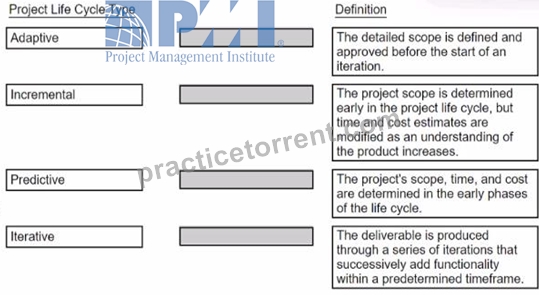
Answer:
Explanation: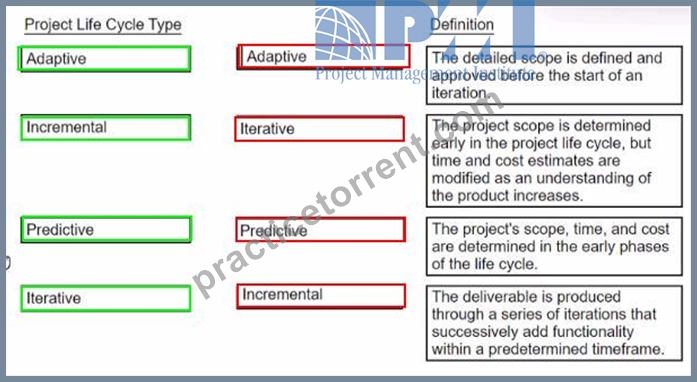
NEW QUESTION # 193
What tool or technique uses an algorithm or statistical relationship between historical data and other variables to calculate an activity's needed resource quantities?
- A. Parametric estimating
- B. Analogous estimating
- C. Bottom-up estimating
- D. Expert judgment
Answer: A
Explanation:
Section: Volume E
NEW QUESTION # 194
What purpose does the hierarchical locus of stakeholder communications serve?
- A. Sustains the focus on general communication activities using email, social media, and websites
- B. Preserves the tocus on external stakeholders-such as customers and vendors-as well as on other projects
- C. Maintains the focus on project and organizational stakeholders
- D. Keeps the focus on the position of the stakeholder or group with respect to the project team
Answer: A
NEW QUESTION # 195
Processes in the Planning Process Group are typically carried out during which part of the project life cycle?
- A. At the beginning and the end
- B. Repeatedly
- C. Once during each phase
- D. Only once, at the beginning
Answer: B
Explanation:
Section: Volume A
NEW QUESTION # 196
......
Exam Passing Guarantee CAPM Exam with Accurate Quastions: https://www.practicetorrent.com/CAPM-practice-exam-torrent.html
Test Engine to Practice Test for CAPM Valid and Updated Dumps: https://drive.google.com/open?id=18W-zhUtYFq2RuscK-RHyb-lvMMKY7jWi