


Achieve The Utmost Performance In AZ-204 Exam Pass Guaranteed
Achive your Success with Latest Microsoft AZ-204 Exam
AZ-204: Developing Solutions for Microsoft Azure Exam Certified Professional salary
The average salary of a AZ-204: Developing Solutions for Microsoft Azure Exam Certified Expert in
- United State - 120,000 USD
- England - 90,532 POUND
- Europe - 90,547 EURO
- India - 20,00,327 INR
Details of the Microsoft AZ-204 exam
This certification exam is made up of 40-60 questions covering different formats. These include multiple-choice and multiple-response questions, scenario-based items, build list, active screen, drag and drop, and short answer. The passing score for the test is 700 points and you need to get it within 150 minutes. The exam is available in English, Korean, Japanese, and Simplified Chinese. To take it, the applicants have to pay the fee of $165 and register with Pearson VUE. You need to cover the exam topics using study resources and take a lot of practice tests and exam dumps to get this passing score. The objectives covered in the certification test are listed below:
- Developing for Azure storage: 10-15%;
- Implementing Azure security: 15-20%;
- Developing Azure compute solutions: 25-30%;
- Connecting to and consuming Azure services & 3rd-party services: 25-30%;
- Monitoring, troubleshooting, and optimizing Azure solutions: 10-15%.
The exam blueprint has the details of each of these topics and the areas that the candidates need to focus on during the preparation phase. You should spend time going through the blueprint before choosing your study materials.
NEW QUESTION 125
You are developing a microservices solution. You plan to deploy the solution to a multinode Azure Kubernetes Service (AKS) cluster.
You need to deploy a solution that includes the following features:
reverse proxy capabilities
configurable traffic routing
TLS termination with a custom certificate
Which components should you use? To answer, drag the appropriate components to the correct requirements. Each component may be used once, more than once, or not at all. You may need to drag the split bar between panes or scroll to view content.
NOTE: Each correct selection is worth one point.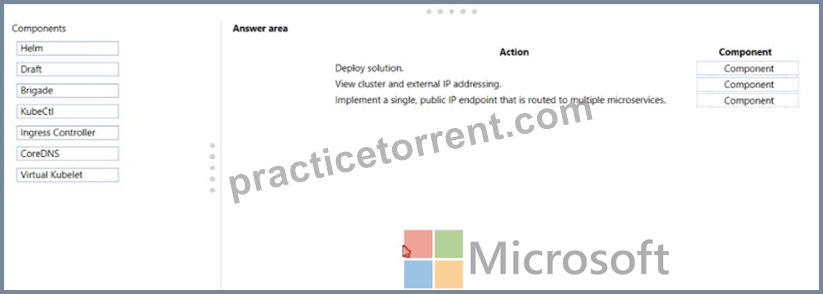
Answer:
Explanation: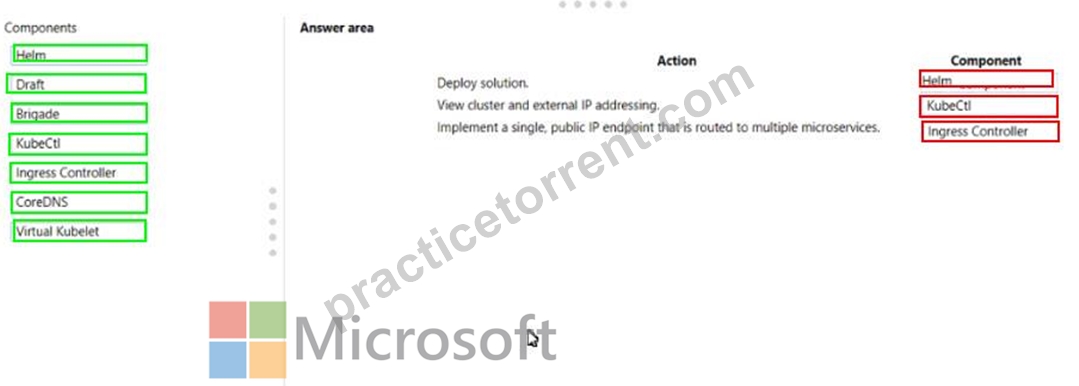
Reference:
https://docs.microsoft.com/bs-cyrl-ba/azure/aks/ingress-basic
https://www.digitalocean.com/community/tutorials/how-to-inspect-kubernetes-networking
NEW QUESTION 126
You are a developer for a Software as a Service (SaaS) company. You develop solutions that provide the ability to send notifications by using Azure Notification Hubs.
You need to create sample code that customers can use as a reference for how to send raw notifications to Windows Push Notification Services (WNS) devices. The sample code must not use external packages.
How should you complete the code segment? To answer, drag the appropriate code segments to the correct locations. Each code segment may be used once, more than once, or not at all. You may need to drag the split bar between panes or scroll to view content.
NOTE: Each correct selection is worth one point.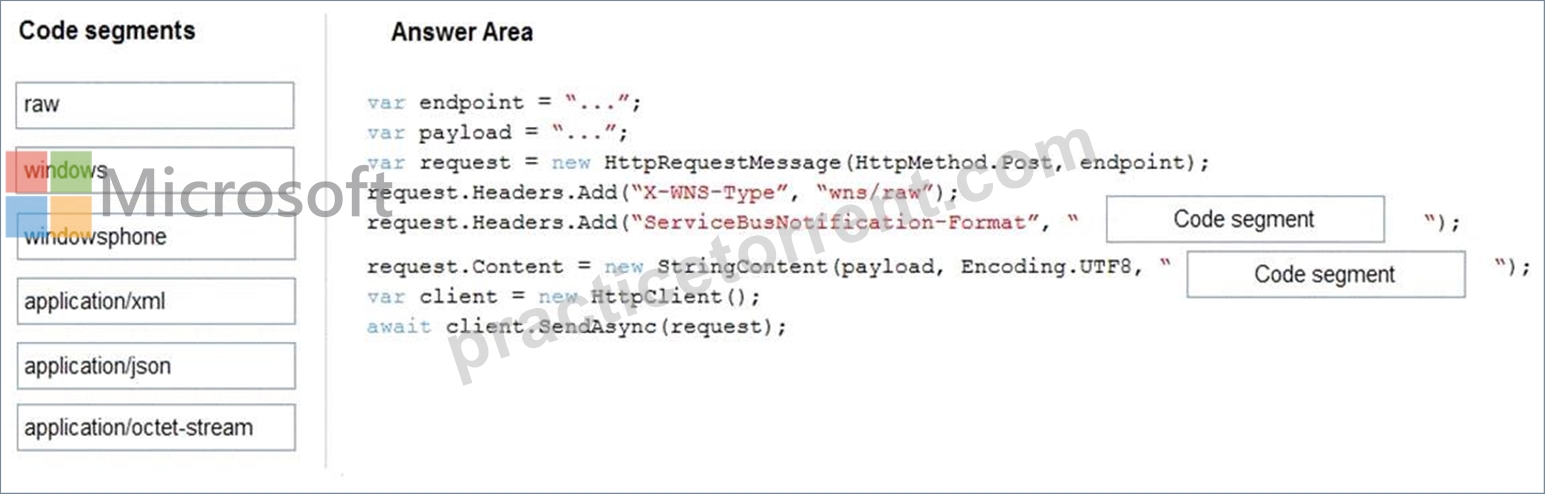
Answer:
Explanation: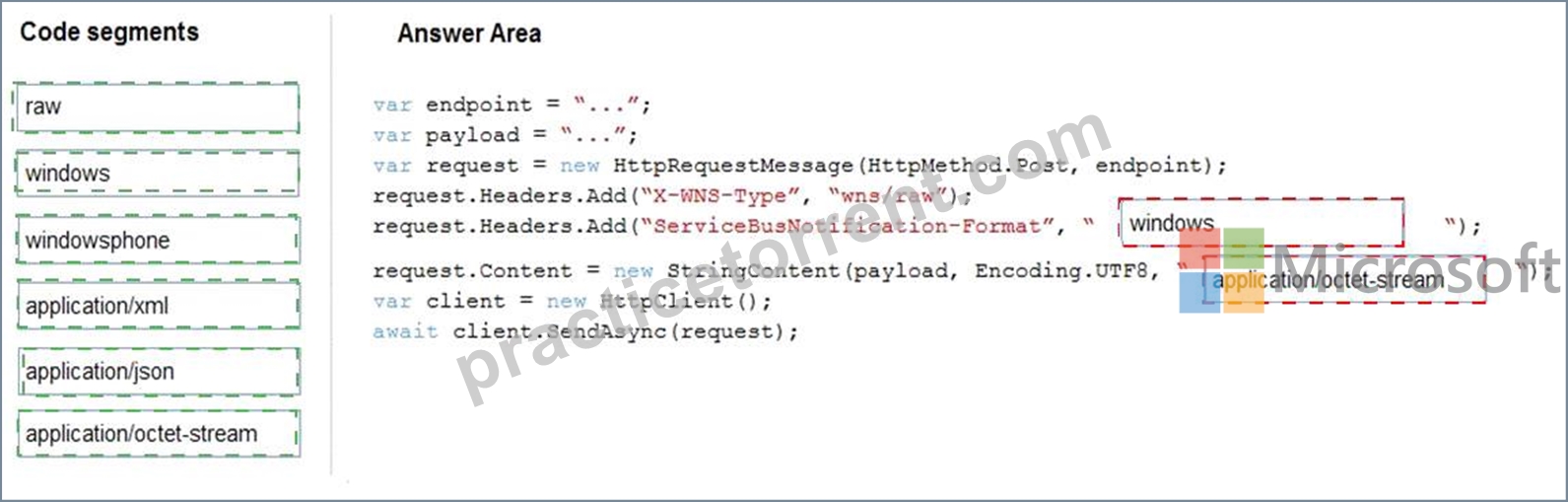
Explanation
Graphical user interface, text, application, email Description automatically generated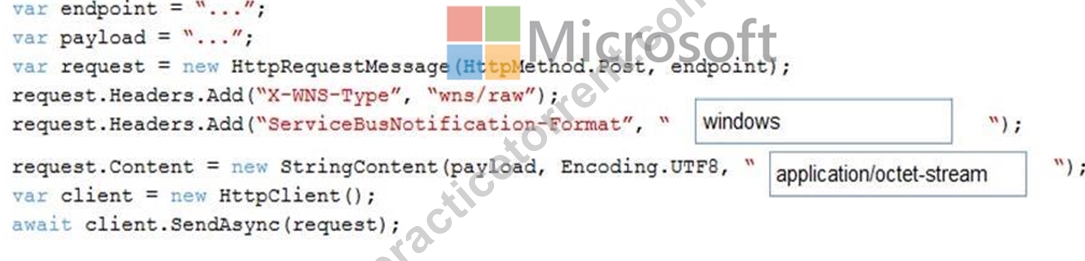
Box 1: windows
Example code:
var request = new HttpRequestMessage(method, $"{resourceUri}?api-version=2017-04"); request.Headers.Add("Authorization", createToken(resourceUri, KEY_NAME, KEY_VALUE)); request.Headers.Add("X-WNS-Type", "wns/raw"); request.Headers.Add("ServiceBusNotification-Format", "windows"); return request; Box 2: application/octet-stream Example code capable of sending a raw notification:
string resourceUri = $"https://{NH_NAMESPACE}.servicebus.windows.net/{HUB_NAME}/messages/"; using (var request = CreateHttpRequest(HttpMethod.Post, resourceUri))
{
request.Content = new StringContent(content, Encoding.UTF8, "application/octet-stream"); request.Content.Headers.ContentType.CharSet = string.Empty; var httpClient = new HttpClient(); var response = await httpClient.SendAsync(request); Console.WriteLine(response.StatusCode);
}
Reference:
https://stackoverflow.com/questions/31346714/how-to-send-raw-notification-to-azure-notification-hub/31347901
NEW QUESTION 127
Your company is developing an Azure API hosted in Azure.
You need to implement authentication for the Azure API to access other Azure resources. You have the following requirements:
* All API calls must be authenticated.
* Callers to the API must not send credentials to the API.
Which authentication mechanism should you use?
- A. Basic
- B. Managed identity
- C. Anonymous
- D. Client certificate
Answer: B
Explanation:
Azure Active Directory Managed Service Identity (MSI) gives your code an automatically managed identity for authenticating to Azure services, so that you can keep credentials out of your code.
Note: Use the authentication-managed-identity policy to authenticate with a backend service using the managed identity. This policy essentially uses the managed identity to obtain an access token from Azure Active Directory for accessing the specified resource. After successfully obtaining the token, the policy will set the value of the token in the Authorization header using the Bearer scheme.
Incorrect Answers:
A: Use the authentication-basic policy to authenticate with a backend service using Basic authentication. This policy effectively sets the HTTP Authorization header to the value corresponding to the credentials provided in the policy.
B: Anonymous is no authentication at all.
D: Your code needs credentials to authenticate to cloud services, but you want to limit the visibility of those credentials as much as possible. Ideally, they never appear on a developer's workstation or get checked-in to source control. Azure Key Vault can store credentials securely so they aren't in your code, but to retrieve them you need to authenticate to Azure Key Vault. To authenticate to Key Vault, you need a credential! A classic bootstrap problem.
Reference:
https://azure.microsoft.com/en-us/blog/keep-credentials-out-of-code-introducing-azure-ad-managed-service- identity/
https://docs.microsoft.com/en-us/azure/api-management/api-management-authentication-policies Monitor, troubleshoot, and optimize Azure solutions Testlet 1 Case study This is a case study. Case studies are not timed separately. You can use as much exam time as you would like to complete each case. However, there may be additional case studies and sections on this exam.
You must manage your time to ensure that you are able to complete all questions included on this exam in the time provided.
To answer the questions included in a case study, you will need to reference information that is provided in the case study. Case studies might contain exhibits and other resources that provide more information about the scenario that is described in the case study. Each question is independent of the other questions in this case study.
At the end of this case study, a review screen will appear. This screen allows you to review your answers and to make changes before you move to the next section of the exam. After you begin a new section, you cannot return to this section.
To start the case study
To display the first question in this case study, click the Next button. Use the buttons in the left pane to explore the content of the case study before you answer the questions. Clicking these buttons displays information such as business requirements, existing environment, and problem statements. When you are ready to answer a question, click the Question button to return to the question.
Background
Overview
You are a developer for Contoso, Ltd. The company has a social networking website that is developed as a Single Page Application (SPA). The main web application for the social networking website loads user uploaded content from blob storage.
You are developing a solution to monitor uploaded data for inappropriate content. The following process occurs when users upload content by using the SPA:
* Messages are sent to ContentUploadService.
* Content is processed by ContentAnalysisService.
* After processing is complete, the content is posted to the social network or a rejection message is posted in its place.
The ContentAnalysisService is deployed with Azure Container Instances from a private Azure Container Registry named contosoimages.
The solution will use eight CPU cores.
Azure Active Directory
Contoso, Ltd. uses Azure Active Directory (Azure AD) for both internal and guest accounts.
Requirements
ContentAnalysisService
The company's data science group built ContentAnalysisService which accepts user generated content as a string and returns a probable value for inappropriate content. Any values over a specific threshold must be reviewed by an employee of Contoso, Ltd.
You must create an Azure Function named CheckUserContent to perform the content checks.
Costs
You must minimize costs for all Azure services.
Manual review
To review content, the user must authenticate to the website portion of the ContentAnalysisService using their Azure AD credentials. The website is built using React and all pages and API endpoints require authentication.
In order to review content a user must be part of a ContentReviewer role. All completed reviews must include the reviewer's email address for auditing purposes.
High availability
All services must run in multiple regions. The failure of any service in a region must not impact overall application availability.
Monitoring
An alert must be raised if the ContentUploadService uses more than 80 percent of available CPU cores.
Security
You have the following security requirements:
* Any web service accessible over the Internet must be protected from cross site scripting attacks.
* All websites and services must use SSL from a valid root certificate authority.
* Azure Storage access keys must only be stored in memory and must be available only to the service.
* All Internal services must only be accessible from internal Virtual Networks (VNets).
* All parts of the system must support inbound and outbound traffic restrictions.
* All service calls must be authenticated by using Azure AD.
User agreements
When a user submits content, they must agree to a user agreement. The agreement allows employees of Contoso, Ltd. to review content, store cookies on user devices, and track user's IP addresses.
Information regarding agreements is used by multiple divisions within Contoso, Ltd.
User responses must not be lost and must be available to all parties regardless of individual service uptime.
The volume of agreements is expected to be in the millions per hour.
Validation testing
When a new version of the ContentAnalysisService is available the previous seven days of content must be processed with the new version to verify that the new version does not significantly deviate from the old version.
Issues
Users of the ContentUploadService report that they occasionally see HTTP 502 responses on specific pages.
Code
ContentUploadService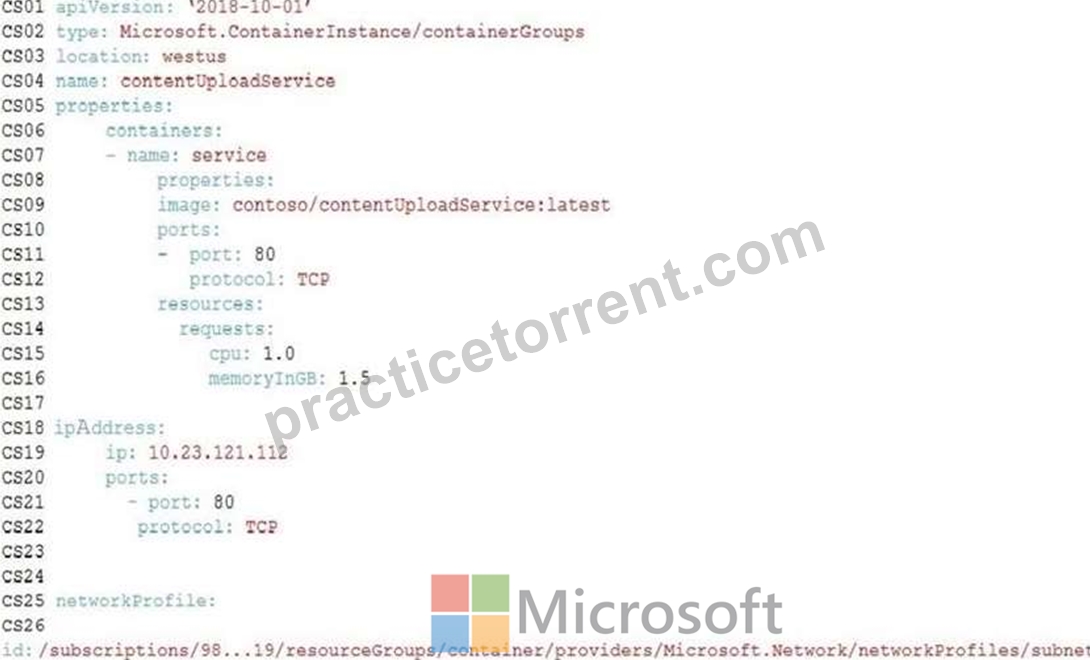
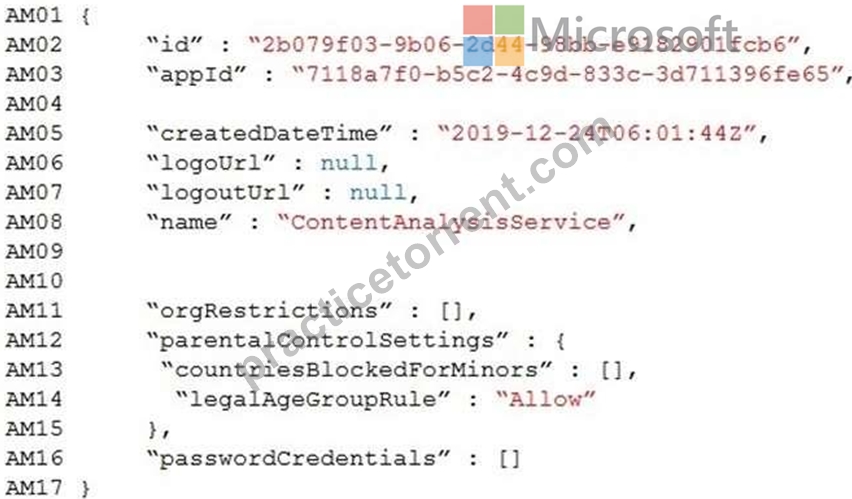
NEW QUESTION 128
You are developing an Azure-hosted application that must use an on-premises hardware security module (HSM) key.
The key must be transferred to your existing Azure Key Vault by using the Bring Your Own Key (BYOK) process.
You need to securely transfer the key to Azure Key Vault.
Which four actions should you perform in sequence? To answer, move the appropriate actions from the list of actions to the answer area and arrange them in the correct order.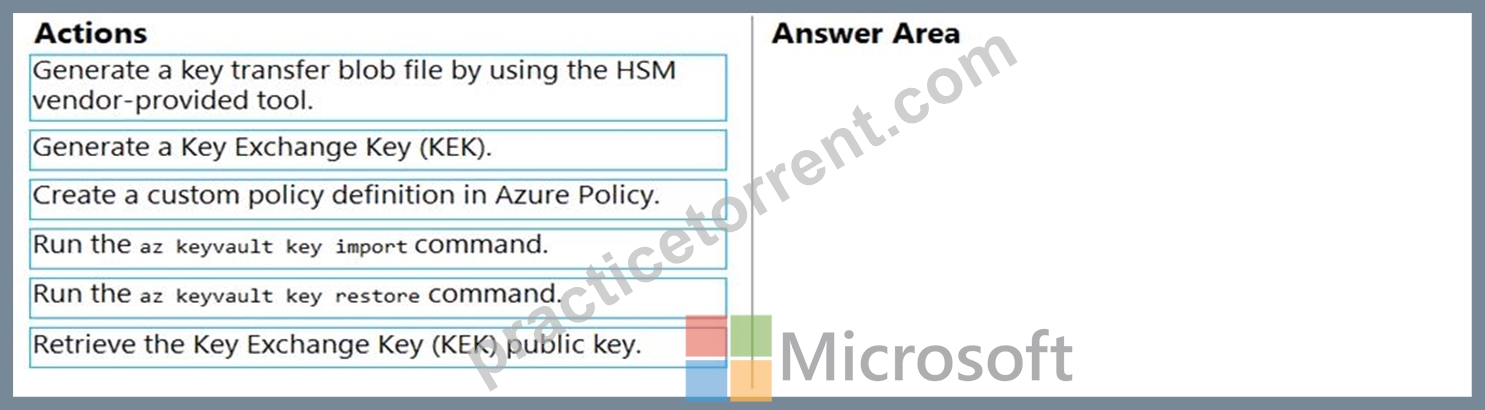
Answer:
Explanation: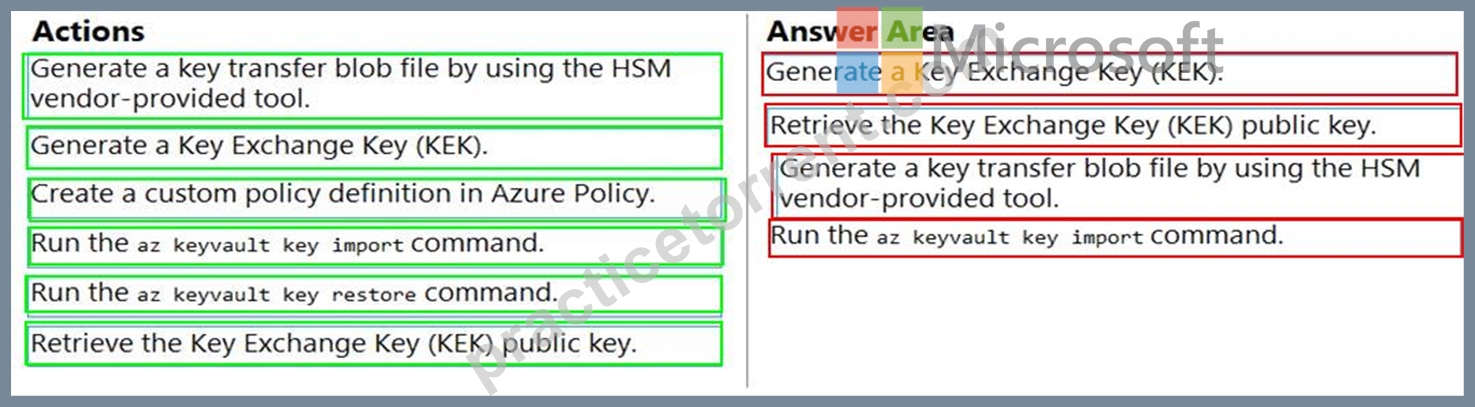
Reference:
https://docs.microsoft.com/en-us/azure/key-vault/keys/byok-specification
NEW QUESTION 129
Contoso, Ltd. provides an API to customers by using Azure API Management (APIM). The API authorizes users with a JWT token.
You must implement response caching for the APIM gateway. The caching mechanism must detect the user ID of the client that accesses data for a given location and cache the response for that user ID.
You need to add the following policies to the policies file:
* a set-variable policy to store the detected user identity
* a cache-lookup-value policy
* a cache-store-value policy
* a find-and-replace policy to update the response body with the user profile information To which policy section should you add the policies? To answer, drag the appropriate sections to the correct policies. Each section may be used once, more than once, or not at all. You may need to drag the split bar between panes or scroll to view content NOTE: Each correct selection is worth one point
Answer:
Explanation:
Explanation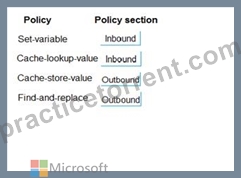
Box 1: Inbound.
A set-variable policy to store the detected user identity.
Example:
<policies>
<inbound>
<!-- How you determine user identity is application dependent -->
<set-variable
name="enduserid"
value="@(context.Request.Headers.GetValueOrDefault("Authorization","").Split(' ')[1].AsJwt()?.Subject)" /> Box 2: Inbound A cache-lookup-value policy Example:
<inbound>
<base />
<cache-lookup vary-by-developer="true | false" vary-by-developer-groups="true | false" downstream-caching-type="none | private | public" must-revalidate="true | false">
<vary-by-query-parameter>parameter name</vary-by-query-parameter> <!-- optional, can repeated several times -->
</cache-lookup>
</inbound>
Box 3: Outbound
A cache-store-value policy.
Example:
<outbound>
<base />
<cache-store duration="3600" />
</outbound>
Box 4: Outbound
A find-and-replace policy to update the response body with the user profile information.
Example:
<outbound>
<!-- Update response body with user profile-->
<find-and-replace
from='"$userprofile$"'
to="@((string)context.Variables["userprofile"])" />
<base />
</outbound>
Reference:
https://docs.microsoft.com/en-us/azure/api-management/api-management-caching-policies
https://docs.microsoft.com/en-us/azure/api-management/api-management-sample-cache-by-key
NEW QUESTION 130
You are developing an Azure solution.
You need to develop code to access a secret stored in Azure Key Vault.
How should you complete the code segment? To answer, drag the appropriate code segments to the correct locations. Each code segment may be used once, more than once, or not at all. You may need to drag the split bar between panes or scroll to view content.
NOTE: Each correct selection is worth one point.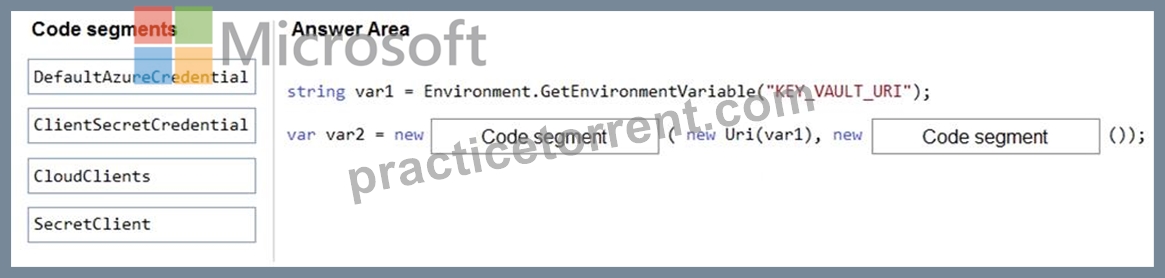
Answer:
Explanation: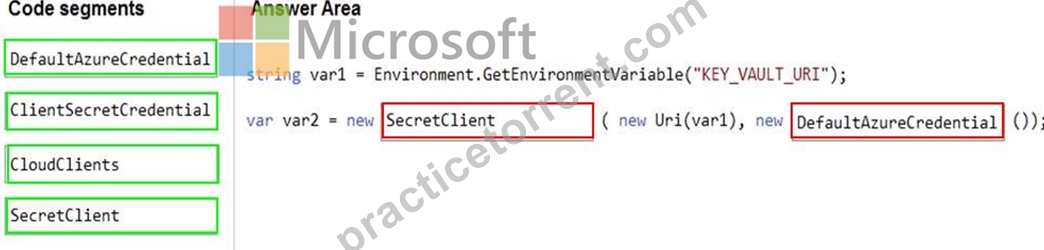
Reference:
https://docs.microsoft.com/en-us/azure/key-vault/secrets/quick-create-net
NEW QUESTION 131
You are developing a .NET Core MVC application for customers to research hotels. The application will use Azure Search. The application will search the index by using various criteria to locate documents related to hotels. The index will include search fields for rate, a list of amenities, and distance to the nearest airport.
The application must support the following scenarios for specifying search criteria and organizing results:
* Search the index by using regular expressions.
* Organize results by counts for name-value pairs.
* List hotels within a specified distance to an airport and that fall within a specific price range.
You need to configure the SearchParameters class.
Which properties should you configure? To answer, select the appropriate options in the answer area.
NOTE Each correct selection is worth one point.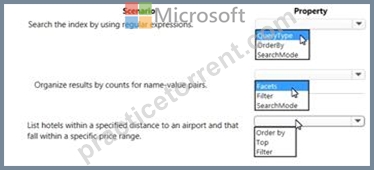
Answer:
Explanation: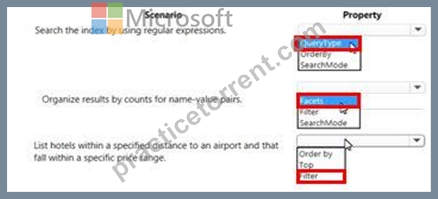
NEW QUESTION 132
You are working for Contoso, Ltd.
You define an API Policy object by using the following XML markup: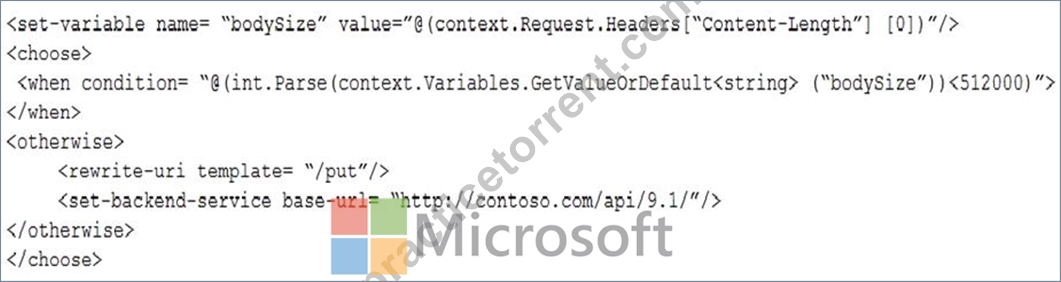
For each of the following statements, select Yes if the statement is true. Otherwise, select No.
NOTE: Each correct selection is worth one point.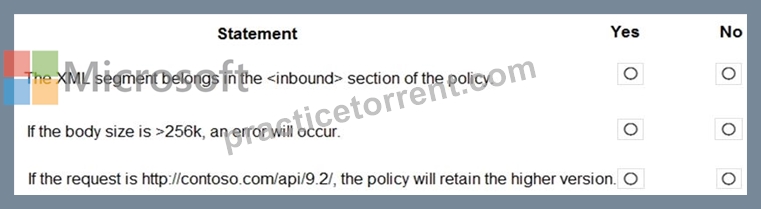
Answer:
Explanation: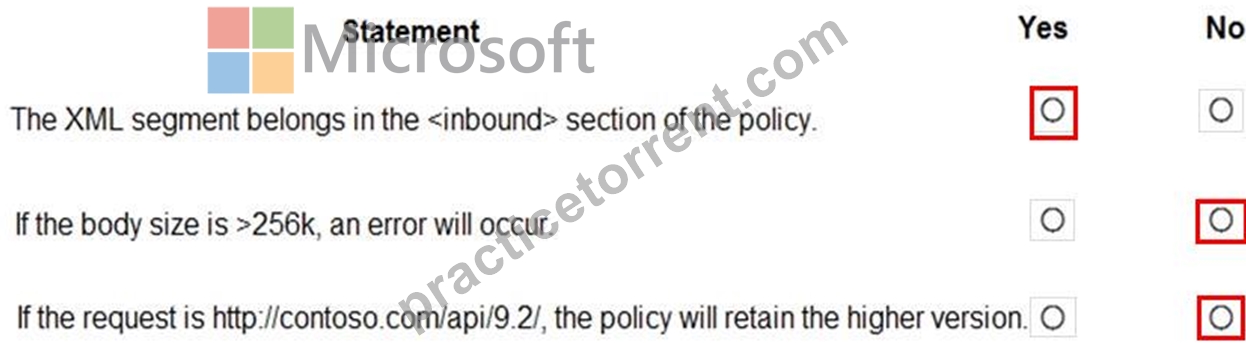
Reference:
https://docs.microsoft.com/en-us/azure/api-management/api-management-transformation-policies
NEW QUESTION 133
You are developing a ticket reservation system for an airline.
The storage solution for the application must meet the following requirements:
* Ensure at least 99.99% availability and provide low latency.
* Accept reservations event when localized network outages or other unforeseen failures occur.
* Process reservations in the exact sequence as reservations are submitted to minimize overbooking or selling the same seat to multiple travelers.
* Allow simultaneous and out-of-order reservations with a maximum five-second tolerance window.
You provision a resource group named airlineResourceGroup in the Azure South-Central US region.
You need to provision a SQL SPI Cosmos DB account to support the app.
How should you complete the Azure CLI commands? To answer, select the appropriate options in the answer area.
NOTE: Each correct selection is worth one point.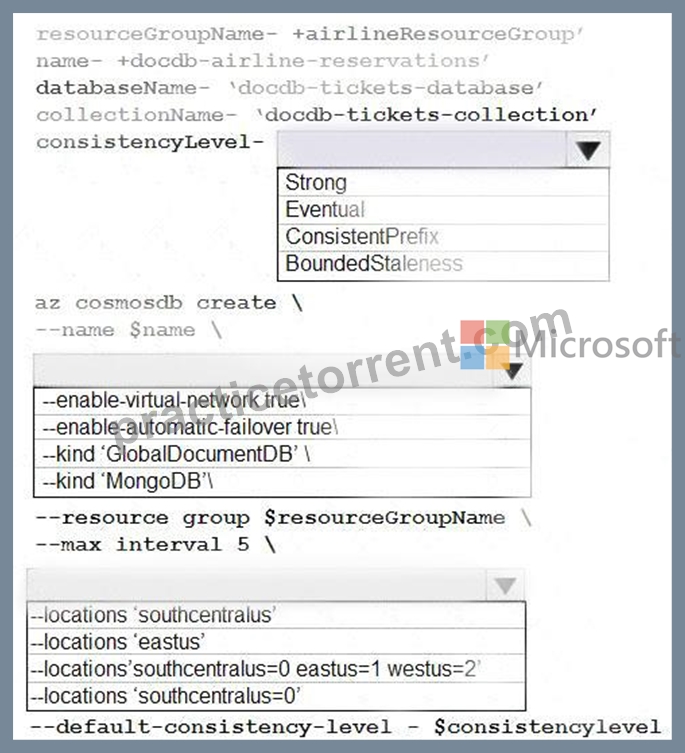
Answer:
Explanation: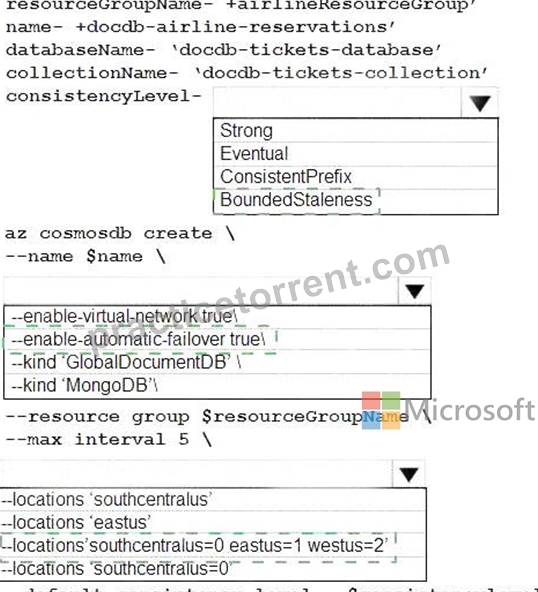
Explanation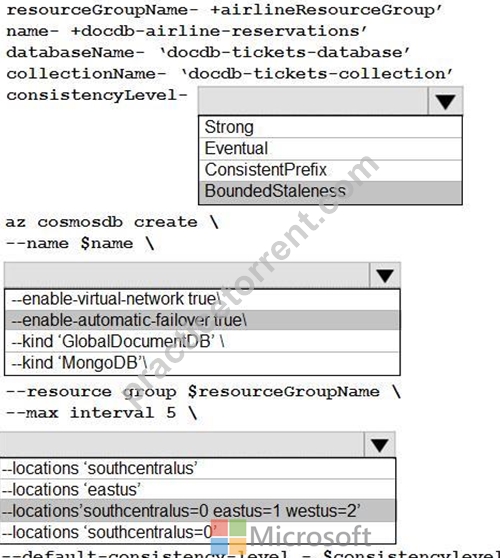
Box 1: BoundedStaleness
Bounded staleness: The reads are guaranteed to honor the consistent-prefix guarantee. The reads might lag behind writes by at most "K" versions (that is, "updates") of an item or by "T" time interval. In other words, when you choose bounded staleness, the "staleness" can be configured in two ways:
The number of versions (K) of the item
The time interval (T) by which the reads might lag behind the writes
Reference:
https://docs.microsoft.com/en-us/azure/cosmos-db/consistency-levels
https://github.com/MicrosoftDocs/azure-docs/blob/master/articles/cosmos-db/manage-with-cli.md
NEW QUESTION 134
You develop a news and blog content app for Windows devices.
A notification must arrive on a user's device when there is a new article available for them to view.
You need to implement push notifications.
How should you complete the code segment? To answer, select the appropriate options in the answer area.
NOTE: Each correct selection is worth one point.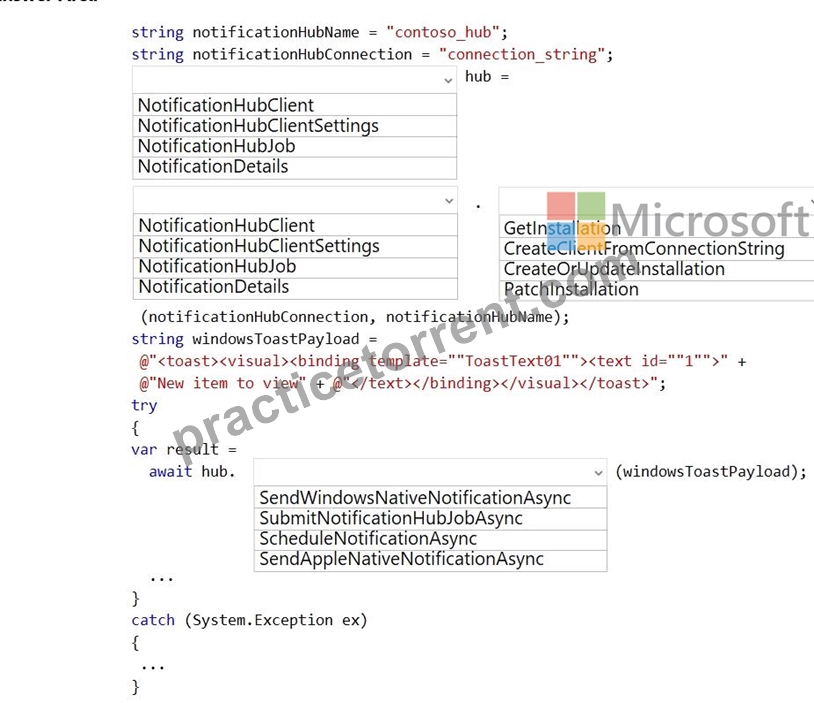
Answer:
Explanation: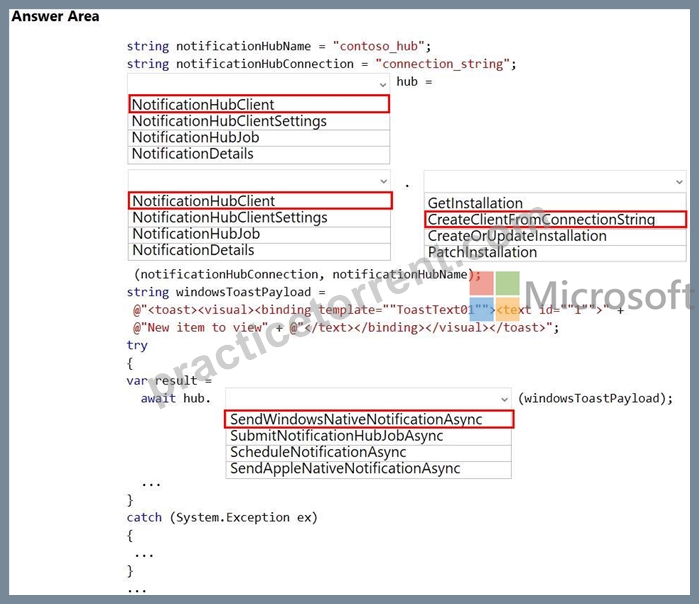
Reference:
https://docs.microsoft.com/en-us/azure/notification-hubs/notification-hubs-push-notification-registration-management
https://github.com/MicrosoftDocs/azure-docs/blob/master/articles/app-service-mobile/app-service-mobile-windows-store-dotnet-get-started-push.md
NEW QUESTION 135
You are developing an ASP.NET Core Web API web service that uses Azure Application Insights to monitor performance and track events.
You need to enable logging and ensure that log messages can be correlated to events tracked by Application Insights.
How should you complete the code? To answer, drag the appropriate code segments to the correct locations. Each code segment may be used once, more than once, or not at all. You may need to drag the split bar between panes or scroll to view content.
NOTE: Each correct selection is worth one point.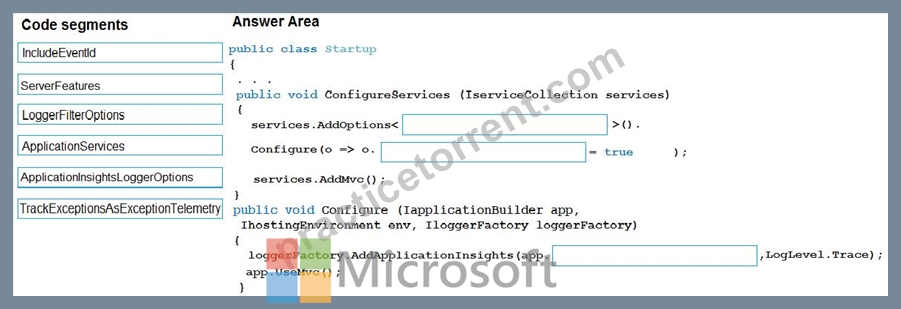
Answer:
Explanation: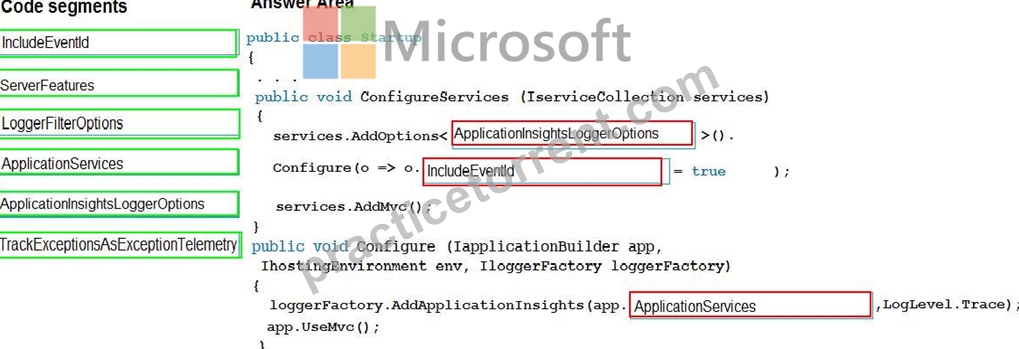
Reference:
https://blog.computedcloud.com/enabling-application-insights-trace-logging-in-asp-net-core/
NEW QUESTION 136
A company is developing a solution that allows smart refrigerators to send temperature information to a central location. You have an existing Service Bus.
The solution must receive and store message until they can be processed. You create an Azure Service Bus Instance by providing a name, pricing tier, subscription, resource group, and location.
You need to complete the configuration.
Which Azure CLI or PowerShell command should you run?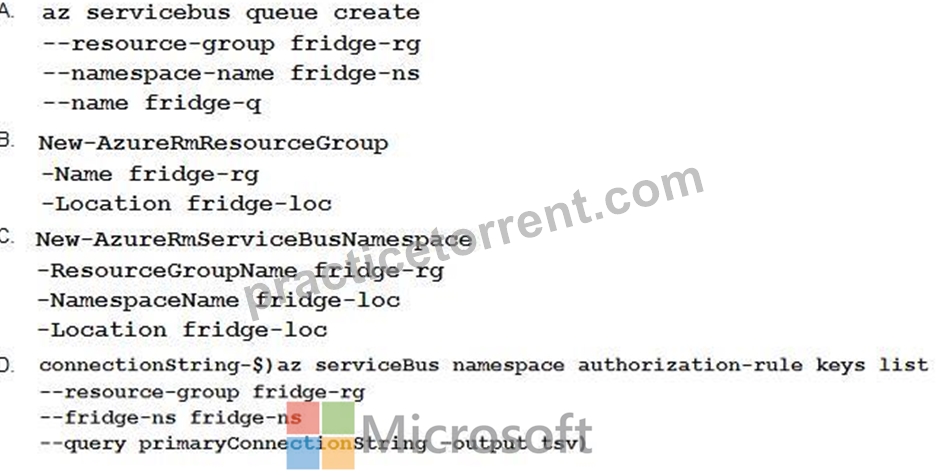
- A. Option C
- B. Option A
- C. Option B
- D. Option D
Answer: B
Explanation:
Explanation
A service bus instance has already been created (Step 2 below). Next is step 3, Create a Service Bus queue.
Note:
Steps:
Step 1: # Create a resource group
resourceGroupName="myResourceGroup"
az group create --name $resourceGroupName --location eastus
Step 2: # Create a Service Bus messaging namespace with a unique name
namespaceName=myNameSpace$RANDOM
az servicebus namespace create --resource-group $resourceGroupName --name $namespaceName --location eastus Step 3: # Create a Service Bus queue az servicebus queue create --resource-group $resourceGroupName --namespace-name $namespaceName
--name BasicQueue
Step 4: # Get the connection string for the namespace
connectionString=$(az servicebus namespace authorization-rule keys list --resource-group
$resourceGroupName --namespace-name $namespaceName --name RootManageSharedAccessKey --query primaryConnectionString --output tsv) Reference:
https://docs.microsoft.com/en-us/azure/service-bus-messaging/service-bus-quickstart-cli
NEW QUESTION 137
You are developing an ASP.NET Core Web API web service that uses Azure Application Insights to monitor performance and track events.
You need to enable logging and ensure that log messages can be correlated to events tracked by Application Insights.
How should you complete the code? To answer, drag the appropriate code segments to the correct locations. Each code segment may be used once, more than once, or not at all. You may need to drag the split bar between panes or scroll to view content.
NOTE: Each correct selection is worth one point.
Answer:
Explanation: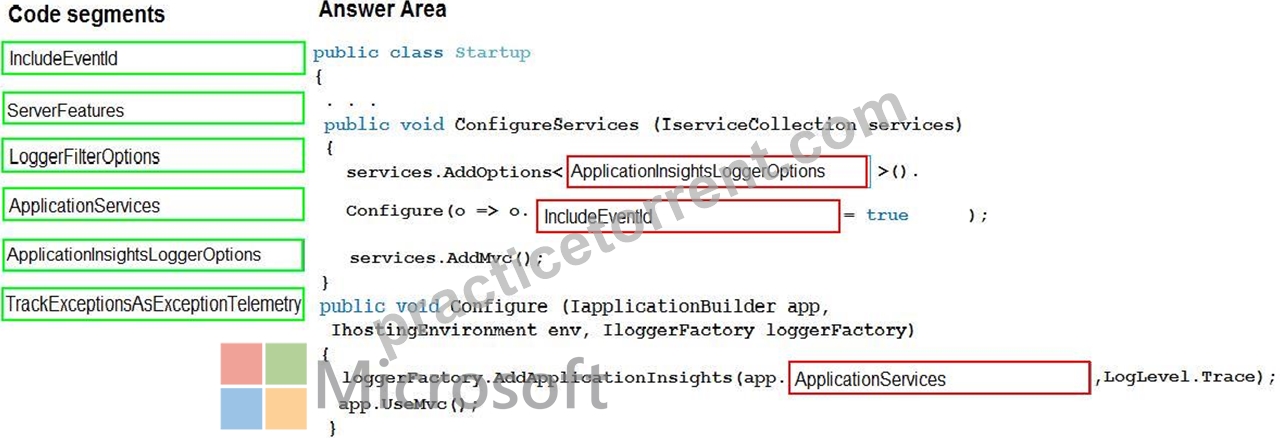
Explanation:
Box 1: ApplicationInsightsLoggerOptions
If you want to include the EventId and EventName properties, then add the following to the ConfigureServices method:
services
.AddOptions<ApplicationInsightsLoggerOptions>()
.Configure(o => o.IncludeEventId = true);
Box 2: IncludeEventID
Box 3: ApplicationServices
In Asp.Net core apps it turns out that trace logs do not show up in Application Insights out of the box. We need to add the following code snippet to our Configure method in Startup.cs:
loggerFactory.AddApplicationInsights(app.ApplicationServices, logLevel); References:
https://blog.computedcloud.com/enabling-application-insights-trace-logging-in-asp-net-core/
NEW QUESTION 138
You are developing a web app that is protected by Azure Web Application Firewall (WAF). All traffic to the web app is routed through an Azure Application Gateway instance that is used by multiple web apps. The web app address is contoso.azurewebsites.net.
All traffic must be secured with SSL. The Azure Application Gateway instance is used by multiple web apps.
You need to configure the Azure Application Gateway for the app.
Which two actions should you perform? Each correct answer presents part of the solution.
NOTE: Each correct selection is worth one point.
- A. In the Azure Application Gateway's HTTP setting, set the value of the Override backend path option to contoso22.azurewebsites.net.
- B. Convert the web app to run in an Azure App service environment (ASE).
- C. In the Azure Application Gateway's HTTP setting, enable the Use for App service setting.
- D. Add an authentication certificate for contoso.azurewebsites.net to the Azure Application gateway.
Answer: A,C
Explanation:
Explanation
D: The ability to specify a host override is defined in the HTTP settings and can be applied to any back-end pool during rule creation.
The ability to derive the host name from the IP or FQDN of the back-end pool members. HTTP settings also provide an option to dynamically pick the host name from a back-end pool member's FQDN if configured with the option to derive host name from an individual back-end pool member.
A (not C): SSL termination and end to end SSL with multi-tenant services.
In case of end to end SSL, trusted Azure services such as Azure App service web apps do not require whitelisting the backends in the application gateway. Therefore, there is no need to add any authentication certificates.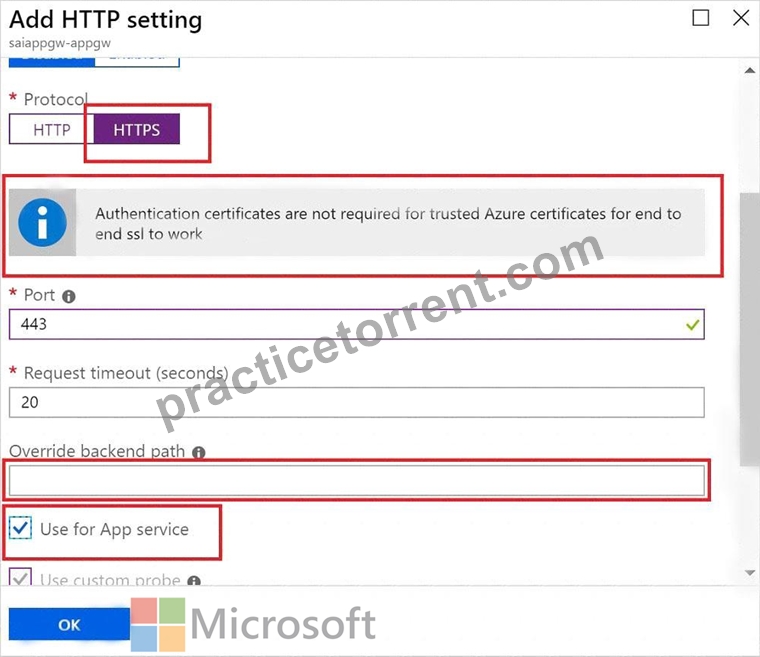
Reference:
https://docs.microsoft.com/en-us/azure/application-gateway/application-gateway-web-app-overview
NEW QUESTION 139
Your company has several websites that use a company logo image. You use Azure Content Delivery Network (CDN) to store the static image.
You need to determine the correct process of how the CDN and the Point of Presence (POP) server will distribute the image and list the items in the correct order.
In which order do the actions occur? To answer, move all actions from the list of actions to the answer area and arrange them in the correct order.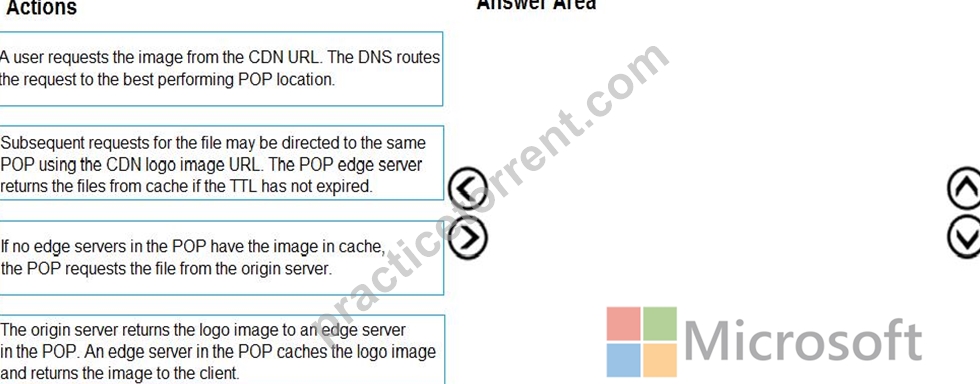
Answer:
Explanation: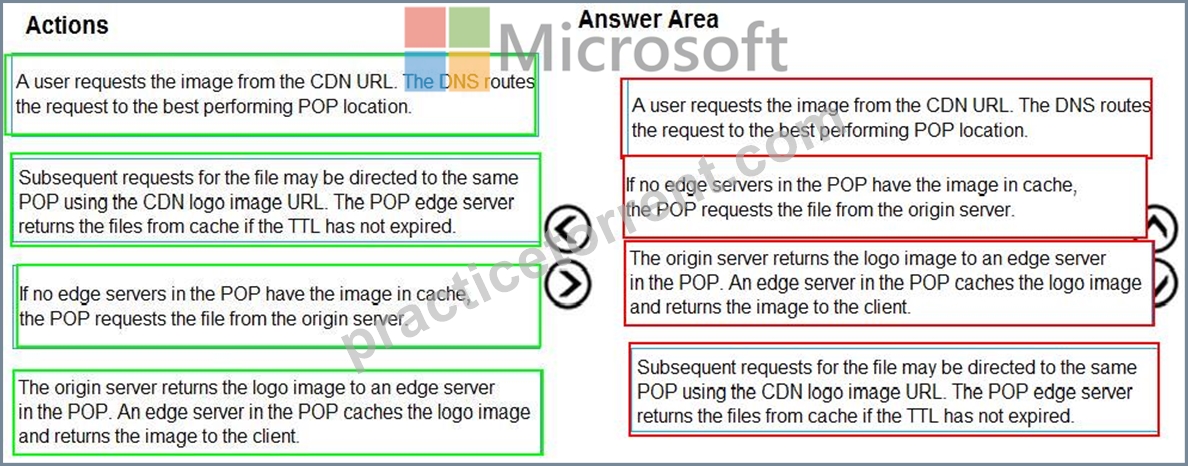
References:
https://docs.microsoft.com/en-us/azure/cdn/cdn-overview
NEW QUESTION 140
You are preparing to deploy a medical records application to an Azure virtual machine (VM). The application will be deployed by using a VHD produced by an on-premises build server.
You need to ensure that both the application and related data are encrypted during and after deployment to Azure.
Which three actions should you perform in sequence? To answer, move the appropriate actions from the list of actions to the answer area and arrange them in the correct order.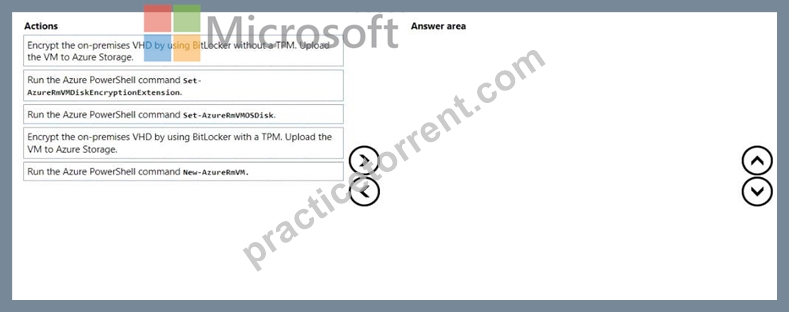
Answer:
Explanation: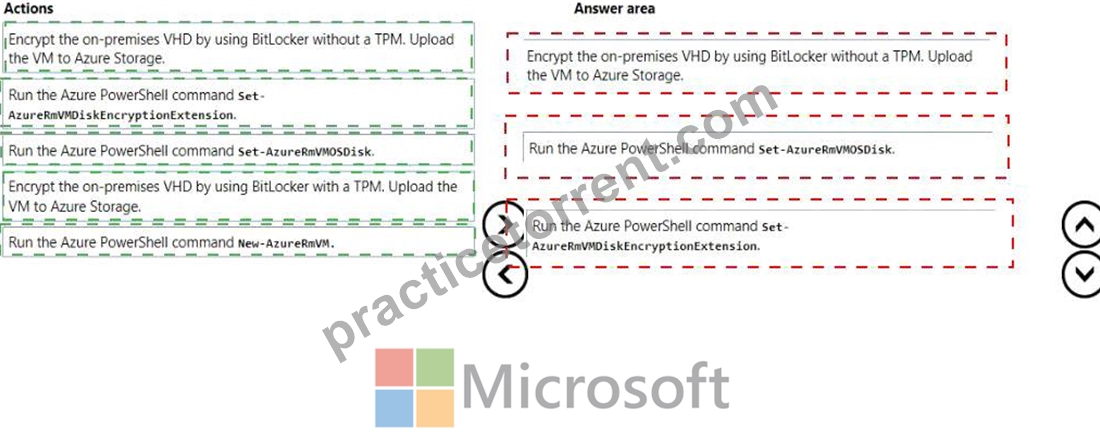
Explanation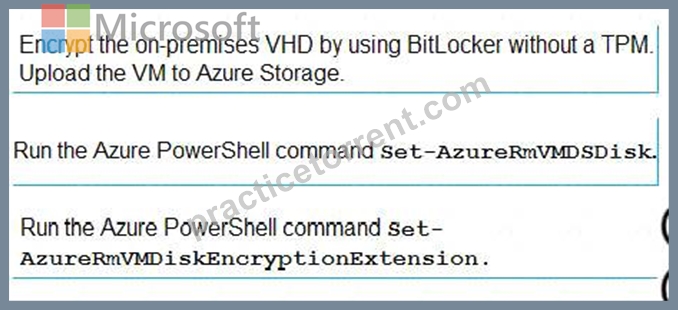
Step 1: Encrypt the on-premises VHD by using BitLocker without a TPM. Upload the VM to Azure Storage Step 2: Run the Azure PowerShell command Set-AzureRMVMOSDisk To use an existing disk instead of creating a new disk you can use the Set-AzureRMVMOSDisk command.
Example:
$osDiskName = $vmname+'_osDisk'
$osDiskCaching = 'ReadWrite'
$osDiskVhdUri = "https://$stoname.blob.core.windows.net/vhds/"+$vmname+"_os.vhd"
$vm = Set-AzureRmVMOSDisk -VM $vm -VhdUri $osDiskVhdUri -name $osDiskName -Create Step 3: Run the Azure PowerShell command Set-AzureRmVMDiskEncryptionExtension Use the Set-AzVMDiskEncryptionExtension cmdlet to enable encryption on a running IaaS virtual machine in Azure.
Incorrect:
Not TPM: BitLocker can work with or without a TPM. A TPM is a tamper resistant security chip on the system board that will hold the keys for encryption and check the integrity of the boot sequence and allows the most secure BitLocker implementation. A VM does not have a TPM.
References:
https://www.itprotoday.com/iaaspaas/use-existing-vhd-azurerm-vm
NEW QUESTION 141
......
Revolutionary Guide To Exam Microsoft Dumps: https://www.practicetorrent.com/AZ-204-practice-exam-torrent.html
The AZ-204 Exam Test For Brief Preparation: https://drive.google.com/open?id=1mUhncfxq24bT-QpeCM2M3MBONb2ZH_nE