


CFE-Financial-Transactions-and-Fraud-Schemes Practice Test Questions Updated 100 Questions
ACFE CFE-Financial-Transactions-and-Fraud-Schemes Dumps - Secret To Pass in First Attempt
ACFE CFE-Financial-Transactions-and-Fraud-Schemes Exam Syllabus Topics:
| Topic | Details |
|---|---|
| Topic 1 |
|
| Topic 2 |
|
| Topic 3 |
|
| Topic 4 |
|
| Topic 5 |
|
NEW QUESTION 54
A tangible asset is one which is:
- A. Both A & B
- B. capable of being perceived
- C. Neither A nor B
- D. capable of being appraised
Answer: A
NEW QUESTION 55
The most basic skimming scheme occurs when:
- A. An employee buy goods or services from a stakeholder, drop the stakeholder's payment and makes record of the purchase too.
- B. An employee sells goods or services to a customer, collects the customer's payment, but makes no record of the sale.
- C. An employee buy goods or services from a customer, drop the customer's payment, but makes no record of the purchase.
- D. An employee sells goods or services to a stakeholder, collects the stakeholder's payment and makes record of the sale too.
Answer: B
NEW QUESTION 56
A particular back surgery contains two basic components (an incision and muscle repair), but it is supposed to be billed using a single procedure code. Heather performs this back surgery on a patient and submits a claim using three codes: one for the full procedure, one for the incision, and one for muscle repair. Which scheme BEST describes Heather's actions?
- A. Upcoding
- B. Unbundling
- C. Over-utilization
- D. Unnecessary services
Answer: A
Explanation:
Explanation/Reference: https://www.acfeinsights.com/acfe-insights/2018/12/12/health-care-fraud-5-common-billing-schemes
NEW QUESTION 57
Green was a salesperson whose job required frequent travel. When Green went on a trip with her family that was not business related, she saved the receipts from her flight, hotel, and restaurant expenses. She turned in these receipts to her manager along with an expense report that described the expenses as business related.
Green's company reimbursed her for the expenses. This is an example of what type of expense reimbursement scheme?
- A. An overstated expense scheme
- B. A mischaracterized expense scheme
- C. A multiple reimbursement scheme
- D. A fictitious expense scheme
Answer: B
Explanation:
Explanation/Reference: https://www.bakertilly.com/insights/expense-reimbursement-schemes
NEW QUESTION 58
The behavior profile of employees who are involved in bribery schemes may include:
- A. Extravagant lifestyle
- B. Gambling habit
- C. Drug and/or alcohol addiction
- D. All of the above
Answer: D
NEW QUESTION 59
_________ is defined as a person who works for the victim organization and who is primary culprit
Answer:
Explanation:
Principal perpetrator
NEW QUESTION 60
According to fraud tree, cash has three following schemes:
- A. Cash distribution, skimming and fraud analysis
- B. Cash larceny, cash distribution and fraudulent disbursements
- C. Fraud analysis, skimming and cash misappropriations
- D. Skimming, cash larceny and fraudulent disbursements
Answer: D
NEW QUESTION 61
Which of the following scenarios describes an electronic funds transfer (EFT) fraud scheme?
- A. An employee of a person-to-person (P2P) provider misrepresents the number of hours they worked to increase the amount of their paycheck.
- B. A person who has stolen information about another person's bank account instructs a biller to obtain payment from that account.
- C. A server secretly scans a customer's credit card information into a small device for fraudulent use at a later time.
- D. A credit card is intercepted in the mail by a thief who proceeds to use the card fraudulently.
Answer: B
Explanation:
Explanation/Reference: https://bjs.ojp.gov/content/pub/pdf/eftsf-cc.pdf
NEW QUESTION 62
Which of the following scenarios is an example of upcoding?
- A. Margot inflates a medical bill she is seeking reimbursement for by adding an additional digit to the amount charged.
- B. Victor receives payment in exchange for undergoing an unnecessary medical procedure that is then billed to his health care program.
- C. Dr. Hernandez uses four procedure codes when submitting a claim for a coronary bypass he performed that is supposed to be billed using a single procedure code.
- D. Dr. Johnson, a psychiatrist, regularly sees patients for sessions lasting less then forty minutes, but she submits the claims with a code that indicates the sessions were sixty minutes long.
Answer: D
Explanation:
Explanation/Reference: https://www.acfeinsights.com/acfe-insights/2018/12/12/health-care-fraud-5-common-billing-schemes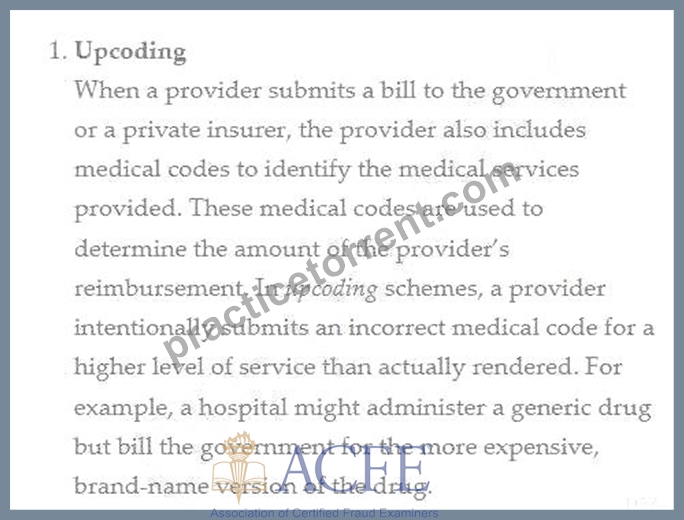
NEW QUESTION 63
Statistical sampling enables the examiner to predict the occurrence rate for the population and therefore determine with some accuracy the error rate, or the potential for fraud.
- A. False
- B. True
Answer: B
NEW QUESTION 64
Which of the following scenarios does NOT describe a card skimming or shimming scheme?
- A. While processing a payment outside of the customer's view, a retail employee uses a small device to scan and record the customer's credit or debit card information.
- B. When paying for a drink at a vending machine, a customer inserts their credit or debit card into a fraudulent device that scans and records their card information.
- C. After processing a customer's payment, a server returns with the receipt but keeps the credit or debit card hoping that the customer does not notice.
- D. A gadget attached to an ATM is used to fraudulently scan and record customers' credit or debit card information while a small camera records their PINs.
Answer: D
Explanation:
Explanation/Reference: https://www.experian.com/blogs/ask-experian/shimming-is-the-latest-credit-card-scam/#:~:text='Shimming'%20is%20an%20update%20on,number%20on%20the%20dark%20web
NEW QUESTION 65
Which of the following is a method that might be used to fraudulently overstate the accounts receivable balance?
- A. Understating net worth
- B. Failing to record depreciation expense
- C. Failing to record bad debt expense
- D. Overstating inventory
Answer: D
NEW QUESTION 66
According to Marshall, ______ are probable future economic benefits obtained or controlled by a particular entity as a result of past transactions or events.
- A. Assets
- B. Liabilities
- C. None of above
- D. Credentials
Answer: A
NEW QUESTION 67
All of the following items appear on the balance sheet EXCEPT:
- A. Assets
- B. Liabilities
- C. Retained earnings
- D. Cost of goods sold
Answer: C
Explanation:
Explanation/Reference: https://www.investopedia.com/articles/fundamental-analysis/10/creative-accounting-balance-sheet.asp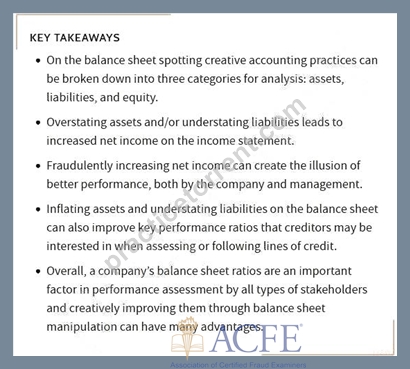
NEW QUESTION 68
When an incorrect total is carried from the journal to the ledger or from ledger to the financial statements, this method is called:
- A. False balance
- B. None of all
- C. Forced Balance
- D. Out-of-balance
Answer: C
NEW QUESTION 69
......
ACFE CFE-Financial-Transactions-and-Fraud-Schemes Exam Dumps [2022] Practice Valid Exam Dumps Question: https://www.practicetorrent.com/CFE-Financial-Transactions-and-Fraud-Schemes-practice-exam-torrent.html