


[UPDATED 2024] WGU Scripting-and-Programming-Foundations Questions Prepare with Free Demo of PDF
NEW 2024 Certification Sample Questions Scripting-and-Programming-Foundations Dumps & Practice Exam
NEW QUESTION # 17
A sample function is shown:
What is returned for F (3)?
- A. 0
- B. 1
- C. 2
- D. 3
Answer: B
Explanation:
Let's evaluate F(3):
* F(3) = (4 * 3) - 8
* F(3) = 12 - 8
* F(3) = 4
NEW QUESTION # 18
What does the following algorithm determine?
- A. Whether x r> negative. 0, <x positive
- B. Whether x is odd
- C. Whether x is evenly divisible by 2 or 3
- D. Whether x is even
Answer: B
Explanation:
The algorithm provided in the image performs a modulo operation with 2 (x % 2) and checks if the result is 1.
In programming, the modulo operation gives the remainder of the division of two numbers. For any integer x, if x % 2 equals 1, it means that x is odd because it has a remainder of 1 when divided by 2. Even numbers, when divided by 2, have no remainder and thus would return 0 in a modulo 2 operation.
References: The explanation is based on the standard definition and behavior of the modulo operation in programming and mathematics. For more information on algorithms and their applications, you can refer to resources such as GeeksforGeeks1 and Built In2.
NEW QUESTION # 19
Which kind of language is HTML?
- A. Dynamically typed
- B. Object-oriented
- C. Markup
- D. Statically typed
Answer: C
Explanation:
HTML stands for HyperText Markup Language. It is a markup language, which means it is used for creating and structuring sections, paragraphs, and links on web pages. It is not a programming language like object-oriented or typed languages; instead, it provides the structure and layout of information on the Internet.
References:
* The definition and classification of HTML as a markup language are standard in web development and can be found in numerous educational resources, including "HTML & CSS: Design and Build Websites" by Jon Duckett and the World Wide Web Consortium's (W3C) HTML5 specification documentation.
NEW QUESTION # 20
A team of programmers describes the objects and functions in a program that compresses files before splitting the objects.
Which two waterfall approach phases are involved?
- A. Design and testing
- B. Implementation and testing
- C. Analysis and implementation
- D. Design and implementation
Answer: D
Explanation:
The Waterfall Model is a sequential design process used in software development, where progress is seen as flowing steadily downwards through several phases like a waterfall. In the context of the question, describing the objects and functions in a program that compresses files before splitting the objects involves two specific phases:
* Design Phase: This is where the system's architecture, components, interfaces, and data are all defined.
The team would design the objects and functions necessary for the file compression program during this phase.
* Implementation (or Development) Phase: Following the design, the actual code is written during the implementation phase. The objects and functions described in the design phase are created and tested to ensure they work as intended.
These two phases are critical in the Waterfall approach for transitioning from an abstract understanding of the problem to a concrete implementation in code. The analysis phase is more about understanding the problem and requirements, while testing is a separate phase that comes after implementation.
References:
* GeeksforGeeks article on Waterfall Model1.
* Built In's explanation of Waterfall Methodology2.
* Forbes Advisor's overview of Waterfall Methodology3.
NEW QUESTION # 21
What is the outcome for the given algorithm? Round to the nearest tenth, if necessary.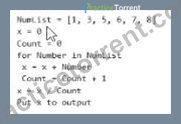
- A. 8.4
- B. 6.1
- C. 5.0
- D. 6.0
Answer: C
Explanation:
* Initialize two variables: x and Count to zero.
* Iterate through each number in the NumList.
* For each number in the list:
* Add the number to x.
* Increment Count by one.
* After processing all numbers in the list, calculate the average:
* Average = x / Count.
The NumList contains the following integers: [1, 3, 5, 6, 7, 8].
Calculating the average: (1 + 3 + 5 + 6 + 7 + 8) / 6 = 30 / 6 = 5.0.
However, none of the provided options match this result. It seems there might be an error in either the options or the calculation.
References: This explanation is based on understanding and analyzing the provided algorithm image; no external references are used.
NEW QUESTION # 22
A software team has been commissioned to create an animation application. Which event takes place during the analysis phase in the agile approach?
- A. Deciding to add five new capabilities to the animation application based on customer feedback
- B. Deciding that new capabilities in the animation application will be written as functions without the needs of any new objects
- C. Writing the code for five new capabilities
- D. Sending the application to customers for additional evaluation after new features are added
Answer: B
Explanation:
* This is the most likely event during the analysis phase. It involves:
* Understanding the requirements: What specific capabilities are needed?
* Breaking down the problem: How can those capabilities be achieved within the existing codebase, potentially by leveraging functions to organize and reuse code.
* Technical Design: Starting to think about the structure of the solution without diving fully into implementation.
NEW QUESTION # 23
What is one task that could be accomplish using a while loop?
- A. The user inputs an integer, and the program prints out whether the number is even or odd and whether the number Is positive, negative, or zero.
- B. A user is asked to enter a password repeatedly until either a correct password is entered or five incorrect attempts have been made.
- C. After inputting two numbers, the program prints out the larger of the two
- D. When the user Inputs a number, the program outputs "True" when the number Is a multiple of 10
Answer: B
Explanation:
A while loop is used to repeatedly execute a block of code as long as a specified condition is true. In the context of the given options:
* Option A could use a simple if-else statement to compare two numbers and print the larger one.
* Option B is a classic example of a use case for a while loop. The loop can run until the correct password is entered or the maximum number of attempts is reached.
* Option C could be accomplished with a single if statement to check if the number is a multiple of 10.
* Option D can also be done with an if-else statement to check the properties of the number.
Therefore, the task that is best suited for a while loop is Option B, where the user is asked to enter a password repeatedly until a correct password is entered or a certain number of incorrect attempts have been made. This requires the program to loop through the password prompt and check the conditions after each input, which is what while loops are designed for.
References:
* "Programming Foundations: Fundamentals" by Simon Allardice, Lynda.com.
* "Introduction to Computer Science and Programming Using Python," MITx on edX.
* "Python Crash Course" by Eric Matthes.
NEW QUESTION # 24
Which characteristic specifically describes an object-oriented language?
- A. Can be run on any machine that has an interpreter
- B. Supports creating programs as a set of functions
- C. Supports creating program as item that have data plus operations
- D. Requires a compiler to convert to machine code
Answer: C
Explanation:
Object-oriented programming (OOP) is characterized by the concept of encapsulating data and operations within objects. This characteristic is fundamental to OOP and distinguishes it from procedural programming, which is structured around functions rather than objects. In OOP, objects are instances of classes, which define the data (attributes) and the operations (methods) that can be performed on that data. This encapsulation of data and methods within objects allows for more modular, reusable, and maintainable code.
References: The characteristics of object-oriented programming languages are well-documented and include encapsulation, abstraction, inheritance, and polymorphism. These principles are foundational to OOP and are supported by languages like C++, Java, and Python12345.
NEW QUESTION # 25
Which operation should be used to check if the difference of two values is greater than 1?
- A. Division
- B. Subtraction
- C. Addition
- D. Multiplication
Answer: B
Explanation:
To determine if the difference between two values is greater than 1, the subtraction operation should be used.
By subtracting one value from the other, you obtain the difference. If this difference is greater than 1, it confirms that the two values are separated by more than a single unit. This is a fundamental operation in programming and mathematics for comparing magnitudes and is supported by the logical comparison operator > which checks if the result of the subtraction is greater than 1123.
References:
* Using Logical Operator to Test 'If Greater Than' Condition1.
* Comparison Operators in Excel2.
* Assembly language comparison technique3.
NEW QUESTION # 26
A function should determine the average of x and y.
What should be the function's parameters and return value(s)?
- A. Parameters: averageReturn values: x, y
- B. Parameters: x, y. averageReturn value: none
- C. Parameters: x, yReturn value: average
- D. Parameters: nonsReturn values: x, y
Answer: C
Explanation:
In programming, a function that calculates the average of two numbers will require both numbers as input to perform the calculation. These inputs are known as parameters. Once the function has completed its calculation, it should return the result. In this case, the result is the average of the two numbers, which is the return value.
Here's a simple example in pseudocode:
function calculateAverage(x, y) {
average = (x + y) / 2
return average
}
In this function, x and y are the parameters, and the average is the calculated value that the function returns after execution.
References:
* Parameters and return values are fundamental concepts in programming that allow functions to receive inputs and return outputs12.
* The syntax and structure of function parameters and return values are consistent across many programming languages, ensuring that a function can perform operations using the provided inputs and then return a result2.
NEW QUESTION # 27
Which characteristic distinguishes an object-oriented language from other languages?
- A. It is extremely portable and can be run on any machine that has a program than can read the code.
- B. It has variables that never change type during execution
- C. lt specifies a series of well-structured steps to compose a program.
- D. It includes custom variable types with methods, information hiding, data abstraction, encapsulation, polymorphism, and inheritance.
Answer: D
Explanation:
The defining characteristic of an object-oriented language is its support for objects and classes, which encapsulate data and behavior. This includes the ability to define custom variable types (classes) with their own methods, and the use of key principles such as information hiding, data abstraction, encapsulation, polymorphism, and inheritance. These features distinguish object-oriented languages from procedural languages, which do not typically support these concepts in the same way.
References: The characteristics of object-oriented programming (OOP) are well-documented and recognized in the field of software development. The information provided aligns with standard definitions and explanations of OOP, as found in educational resources and programming literature123.
NEW QUESTION # 28
Which statement describes a compiled language?
- A. It is considered fairly safe because it forces the programmer to declare all variable types ahead of time and commit to those types during runtime.
- B. It can be run right away without converting the code into an executable file.
- C. It runs one statement at a time by another program without the need for compilation.
- D. It has code that is first converted to an executable file, and then run on a particular type of machine.
Answer: D
Explanation:
A compiled language is one where the source code is translated into machine code, which is a set of instructions that the computer's processor can execute directly. This translation is done by a program called a compiler. Once the source code is compiled into an executable file, it can be run on the target machine without the need for the original source code or the compiler. This process differs from interpreted languages, where the code is executed one statement at a time by another program called an interpreter, and there is no intermediate executable file created.
Option A describes an interpreted language, not a compiled one. Option B refers to type safety, which is a feature of some programming languages but is not specific to compiled languages. Option C describes a script or an interpreted language, which can be executed immediately by an interpreter without compilation.
References: The characteristics of compiled languages are well-documented in computer science literature and online resources. For example, FreeCodeCamp provides an overview of the differences between compiled and interpreted languages1, and the CodeBoss blog offers insights into what a compiled language is and how it functions2. These sources confirm the explanation provided here and offer further reading on the subject.
NEW QUESTION # 29
A programming loam is using the waterfall design approach to create an application. Which deliverable would be produced during the design phase?
- A. The programming paradigm to be used
- B. A written description of the goals for the project
- C. A list of additional features to be added during revision
- D. A report of customer satisfaction
Answer: B
Explanation:
In the Waterfall model, a traditional software development lifecycle (SDLC) methodology, the design phase follows the requirements phase. During the design phase, the focus is on creating a detailed specification of the system to be developed. This includes:
* Architectural Design: Outlining the overall structure of the system.
* Interface Design: Defining how the software components will interact with each other and with users.
* Component Level Design: Specifying the behavior of individual components.
* Data Structure Design: Establishing how data is organized within the system.
The deliverable produced during this phase is a comprehensive design document that describes the architecture, components, interfaces, and data structures of the application in detail. It serves as a blueprint for the next phase of the Waterfall process, which is implementation (coding).
References:
* The explanation is based on the standard practices of the Waterfall model as described in project management and software development resources123.
NEW QUESTION # 30
What is the out of the given pseudocode?
- A. 0
- B. 1
- C. 2
- D. 3
Answer: D
Explanation:
The pseudocode provided appears to be a loop that calculates the sum of numbers. Without seeing the exact pseudocode, I can deduce based on common programming patterns that if the loop is designed to add numbers from 1 to 5, the sum would be 1 + 2 + 3 + 4 + 5, which equals 15. This is a typical example of a series where the sum of the first n natural numbers is given by the formula
2n(n+1)
, and in this case, with n being 5, the sum is
25(5+1)=15
References: This answer is based on the standard algorithm for the sum of an arithmetic series and common looping constructs in programming. The formula for the sum of the first n natural numbers is a well-known result in mathematics and is often used in computer science to describe the behavior of loops and series calculations.
NEW QUESTION # 31
What is a characteristic of an interpreted language?
- A. Has a programmer writing machine code
- B. Can be run by a user one statement at a time
- C. Is restricted to running on one machine
- D. Generates syntax errors during compilation
Answer: B
Explanation:
Interpreted languages are designed to be executed one statement at a time by an interpreter. This allows for immediate execution and feedback, which is useful for debugging and interactive use. Unlike compiled languages, interpreted languages do not generate machine code prior to execution, and they do not produce syntax errors during compilation because there is no compilation step. They are not restricted to one machine, as the interpreter can be implemented on various systems, and they do not require the programmer to write machine code.
References:
* The characteristics of interpreted languages are discussed in educational resources such as
"Programming Language Pragmatics" by Michael L. Scott and "The Art of Computer Programming" by Donald E. Knuth. These texts explain the execution model of interpreted languages and contrast it with that of compiled languages.
NEW QUESTION # 32
......
Scripting-and-Programming-Foundations Deluxe Study Guide with Online Test Engine: https://www.practicetorrent.com/Scripting-and-Programming-Foundations-practice-exam-torrent.html
Scripting-and-Programming-Foundations Test Prep Training Practice Exam Questions Practice Tests: https://drive.google.com/open?id=1TRrYBpqCCDrQAtv1oi0wtAgTkcXJabwK