


Unique Top-selling PEGACPSSA23V1 Exams - New 2024 Pegasystems Pratice Exam
Certified Senior System Architect Dumps PEGACPSSA23V1 Exam for Full Questions - Exam Study Guide
NEW QUESTION # 83
As a best practice, in which situation do you use a keyed data page?
- A. A user selects an emoji from a short list that updates often.
- B. A user selects a replacement part from a long list that seldom changes.
- C. A user selects an image from a long list that updates often.
- D. A user selects a delivery option from a short list that rarely changes.
Answer: B
Explanation:
A keyed data page is best used when a user selects a replacement part from a long list that seldom changes (B).
Keyed data pages are designed to efficiently manage large amounts of data that do not change frequently by loading data specific to a key (like a part ID). This improves performance by caching the data and reducing the need to frequently query the source system for the same data.References: Pega Community documentation on data pages and caching strategies
NEW QUESTION # 84
Graduate school students create and submit project proposals to their advisors. During the proposal phase, the advisor and the student can each edit the draft proposal.
How do you ensure the advisor and the student can simultaneously edit the proposal, and the application can check the proposal for changes before committing them?
- A. Configure the locking on the case type to allow multiple users.
- B. Configure an assignment for the advisor and an assignment for the student.
- C. Configure the student and advisor roles with view and edit permission.
- D. Configure the locking on the case type to allow one user.
Answer: A
Explanation:
To ensure that the advisor and the student can simultaneously edit the draft proposal, configure the locking on the case type to allow multiple users (B). This setting enables a shared access model, where multiple users can work on the case at the same time. Additionally, Pega's conflict resolution mechanisms can be utilized to check for changes before committing them to the database, ensuring that any concurrent edits are properly managed and the integrity of the proposal is maintained.Reference: Pega Community documentation on case locking and concurrent editing.
NEW QUESTION # 85
A data page is used to retrieve data from an external system. If an error occurs, you want to display a message to the user and send an email to the system administrator.
How do you implement this requirement?
- A. Configure an error handling process that displays the error message and sends an email.
- B. Reuse the out-of-the-box ConnectionProblem error handling flow on the Service tab for the connector.
- C. Create an error handler data transform that adds an error message to the data page and sends an email.
- D. Configure an activity's input source as the error message and the output as an email.
Answer: A
Explanation:
The requirement is to handle an error when it occurs and perform two actions: display a message to the user and send an email to the administrator. This can be done by configuring an error handling process that encapsulates both actions. Typically, this would involve configuring a flow or an activity that runs when an error occurs, and it would handle both displaying the error message to the user and sending the email. Reference: Pega Platform Help - Error Handling.
NEW QUESTION # 86
A report needs to list the user ID of the manager of the operator who creates a time-off case. The report provides information from the MyCo-HR-SelfService-Work-TimeOff and Data-Admin-Operator-ID classes.
Which two options independently satisfy the business outcome? (Choose Two)
- A. Specify both classes in the Pages & Classes tab on the report definition.
- B. Use an association rule to join operator information to each case.
- C. Add the operator ID to the report definition as a parameter.
- D. Configure a class join on the report definition to join operator information to each case.
Answer: B,D
Explanation:
* A: Configuring a class join on the report definition allows you to join the operator information to each case, enabling you to list the user ID of the manager associated with the operator who creates a time-off case.
* C: Using an association rule to join operator information to each case accomplishes the same objective by defining a reusable join that can be referenced in multiple reports. References: Pega official documentation on report definitions and associations.
NEW QUESTION # 87
Which two design configurations limit the need for horizontal scrolling when an application is used on a mobile device? (Choose two.)
- A. Limit text fields to a width of 200 pixels.
- B. Set the importance for columns in repeating dynamic layouts.
- C. Set the width for layouts in percentages.
- D. Use grid layouts rather than repeating dynamic layouts to display tabular data.
Answer: B,C
Explanation:
To prevent horizontal scrolling on mobile devices, setting the importance of columns allows for the most critical information to be shown first, potentially hiding less important columns on smaller screens. Using percentage widths for layouts ensures that the layout adapts to the screen width, which can also help prevent horizontal scrolling. References: Pega UI design best practices for mobile devices.
NEW QUESTION # 88
You configure a child case to override the locking strategy of the parent case. The parent case has a time-out value of one hour.
Which time-out value option is recommended for the child case?
- A. Set the Access time-out value less than the parent case time-out value.
- B. Set the Access time-out value equal to the parent case time-out value.
- C. The Access time-out value on the child case cannot be changed.
- D. Set the Access time-out value greater than the parent case time-out value.
Answer: D
Explanation:
The recommended practice is to set the Access time-out value for the child case to be greater than the parent case time-out value. This ensures that the child case does not become inaccessible due to a time-out while the parent case is still active, which could happen if it had the same or a shorter time-out value. Reference: Pega official documentation on locking strategies and time-out values.
NEW QUESTION # 89
Drag the error type on the left to its description on the right.
Answer:
Explanation:
NEW QUESTION # 90
A flow action calls a pre-processing data transform to initiate values. There are several flow actions available for the assignment. You want to make sure that the values are only initiated once for each flow action.
How do you implement a solution?
- A. Configure the data transform as post-processing instead of pre-processing.
- B. Add logic to the pre-processing data transform to test if values were already initiated.
- C. Do nothing. The pre-processing data transform is only called once for each assignment.
- D. Make sure that the flow action does not have the highest likelihood since it will always be invoked.
Answer: B
Explanation:
To ensure that the values are only initiated once for each flow action, add logic to the pre-processing data transform to test if the values were already initiated (A). This logic can prevent the reinitialization of values that have already been set, allowing the pre-processing to only set default values when they are not present, avoiding any unwanted overwrites or duplications of effort.References: Pega Community documentation on data transforms and flow action pre-processing.
NEW QUESTION # 91
Which two tasks are required to build a mobile app from a Pega Platform application? (Choose Two)
- A. Set up push notifications to developers.
- B. Create a certificate set.
- C. Configure access to the Pega Mobile Build Server.
- D. Configure access to Dev Studio.
Answer: B,C
Explanation:
Building a mobile app from a Pega Platform application requires configuring certain key components for security and connectivity. Creating a certificate set (A) is essential for securing the app, ensuring that communications between the mobile app and the server are encrypted and authenticated. Configuring access to the Pega Mobile Build Server (B) is necessary for the app build and distribution process, allowing the Pega application to package and deploy mobile apps through Pega's cloud-based build service.References: Pega Community documentation on mobile app development and deployment.
NEW QUESTION # 92
A hospital uses a case type to manage the treatment of patients visiting the Emergency Room (ER). Cases are created when the patient checks in at the registration desk, and are resolved when the patient is released from the hospital. Stakeholders identify the following security requirements for the case type.
Patients access cases on a read-only basis.
Patients can only access their own cases.
Doctors and nurses can modify cases throughout the case life cycle.
Only doctors are allowed to write prescriptions.
What two steps, when performed together, allow you to ensure that patients can read, but not edit, cases?
(Choose Two)
- A. Create an access group unique to patients.
- B. Configure an Access Role to Object rule with the open case action set to 1.
- C. Configure an Access of Role to Object rule with the open case action set to 5.
- D. Configure an access control policy condition to test whether the user is a patient.
Answer: C
Explanation:
To ensure that patients can read but not edit cases in the hospital's ER case management system, two steps need to be taken. First, configure an Access Role to Object rule with the open case action set to 1 (B), which grants read-only access. This ensures that patients can view their cases without the ability to make any modifications. Secondly, create an access group unique to patients (D). This access group would include the Access Role to Object rule configured in the previous step. By associating patients with this access group, it ensures that they are granted the appropriate level of access to their cases, fulfilling the security requirements specified by the stakeholders.References: Pega Community documentation on Access of Role to Object and access groups.
NEW QUESTION # 93
A view has a part number field that requires the first two characters are letters, and the last four are digits (for example, AB1234).
How do you ensure that the correct pattern is entered when the user exits the field?
- A. Configure a validate rule to use input-qualified validation configuration.
- B. Configure a validate rule on the flow action to validate the field with boolean logic.
- C. Configure an edit validate rule and call it from a validate rule in the relevant flow action.
- D. Configure an edit validate rule and reference it from the property rule for the field.
Answer: D
Explanation:
To ensure that the correct pattern is entered for a part number field, configure an edit validate rule and reference it from the property rule for the field. The edit validate rule can be set up to check that the first two characters are letters and the last four are digits. Reference: Pega official documentation on property rules and edit validate rules.
NEW QUESTION # 94
A music production company's application contains the following classes:
A requirement states that users assigned the role "Manager" can edit objects related to any studio work.
At which position in the class hierarchy do you configure an Access of Role to Object (ARO) record to satisfy this requirement?
- A. UPlusMusic-Production-Work-Studio-Editing
- B. UPlusMusic-Production- Work-
- C. UPlusMusic-Production-Work-Brand-Marketing
- D. UPlusMusic-Production- Work-Studio-
Answer: D
Explanation:
To satisfy the requirement that users assigned the role "Manager" can edit objects related to any studio work, the Access of Role to Object (ARO) record should be configured at the "UPlusMusic-Production-Work-Studio-" level (C). This level is the common parent class for all studio-related work, such as Recording and Editing. By setting the ARO at this level, it ensures that managers have the necessary permissions to edit any object that falls under the studio work hierarchy, without having to set permissions at each individual subclass level.Reference: Pega Community documentation on class hierarchy and Access of Role to Object configuration.
NEW QUESTION # 95
Which two statements about keyed data pages are true? (Choose Two)
- A. A keyed data page is required for all data pages.
- B. A keyed data page can have multiple keys.
- C. A keyed data page can return multiple embedded pages.
- D. A keyed data page can use a report definition.
Answer: B,D
Explanation:
Keyed data pages can return multiple embedded pages if the data structure includes lists or other page structures. They can also have multiple keys, which allows them to return data based on a combination of key values. References: Pega Platform Help - Data Pages.
NEW QUESTION # 96
A client requests that you add a footer to the Case Manager portal. How do you satisfy this request?
- A. Update the portal type on the portal record.
- B. Update the portal format in the skin applied to the portal.
- C. Change the section layout on the harness referenced on the portal record.
- D. Configure a navigation record to describe the new portal format.
Answer: B
Explanation:
Adding a footer to the Case Manager portal can be done by updating the skin that's applied to the portal. Skins in Pega define the look-and-feel of user interfaces, including headers, footers, and other elements. Reference: Pega Platform Help - Skins.
NEW QUESTION # 97
A client requests that you add a footer to the Case Manager portal. How do you satisfy this request?
- A. Update the portal type on the portal record.
- B. Update the portal format in the skin applied to the portal.
- C. Change the section layout on the harness referenced on the portal record.
- D. Configure a navigation record to describe the new portal format.
Answer: B
Explanation:
Adding a footer to the Case Manager portal can be done by updating the skin that's applied to the portal. Skins in Pega define the look-and-feel of user interfaces, including headers, footers, and other elements. References:
Pega Platform Help - Skins.
NEW QUESTION # 98
Multiple teams need to update the same application version during a development cycle.
Which two actions do you perform so that the teams do not affect each other's work? (Choose Two)
- A. Create a new ruleset version for the base application.
- B. Create a separate production ruleset for each team.
- C. Create branches in each team's application.
- D. Create a new application for each team built on the base application.
Answer: C,D
Explanation:
To ensure that multiple teams can update the same application version without affecting each other's work, the following actions are recommended:
B: Create branches for each team's application. This allows teams to work on isolated versions of the application and merge their changes when ready.
D: Create a new application for each team built on the base application. This creates separate instances of the application for each team to work on, which they can then synchronize with the base application as needed. Reference: Pega official documentation on branch rulesets and application development.
NEW QUESTION # 99
An assignment service-level agreement (SLA) is configured with the following details:
* Initial urgency: 20
* Assignment ready: Timed delay of 1 hour
* Goal: 5 hours and increase urgency by 10
* Deadline: 8 hours and increase urgency by 20
* Passed deadline: 2 hours, increase urgency by 20, and limit events to 5 Assuming no other urgency adjustments, what is the assignment urgency 16 hours after the case reaches the assignment.
- A. 0
- B. 1
- C. 2
- D. 3
Answer: C
Explanation:
The initial urgency is set at 20. At 5 hours, the urgency increases by 10 (total 30).
At 8 hours, the urgency increases by 20 (total 50). After the deadline, the urgency increases by 20 every 2 hours, up to a limit of 5 events. By 16 hours, all 5 events have occurred, adding 100 to the urgency, leading to a total urgency of 150 (initial 20 + goal 10 + deadline 20 + passed deadline 100). Reference: Pega Platform Help - Service Level Agreements.
NEW QUESTION # 100
Which two configurations must you make when you add a Split for Each shape to your case life cycle?
(Choose Two)
- A. Define a condition to control when the flow runs for each iteration of the subprocess.
- B. Define when the parent process resumes processing.
- C. Enter a unique name for the shape in the Split for Each field.
- D. Enter the Page List or Page Group property that is the basis of the split.
Answer: B,D
Explanation:
When adding a Split for Each shape to your case life cycle, you must specify the Page List or Page Group property that forms the basis of the split and define when the parent process resumes processing after the iterations of the subprocess are complete. References: Pega Platform Help - Case Design.
NEW QUESTION # 101
In MLP2, the business asks you to create a mobile app for an existing Pega Platform application.
Which two of the following actions are required to create the mobile app? (Choose Two)
- A. Configure the mobile application access in Dev Studio.
- B. Set up push notifications for developers.
- C. Create a certificate set.
- D. Configure access to the Pega Mobile Build Server.
Answer: C,D
NEW QUESTION # 102
You perform a major skim on the ruleset ABC:02-02 to ABC:03-01.
In the Answer area, select the ruleset versions that the skim operation uses.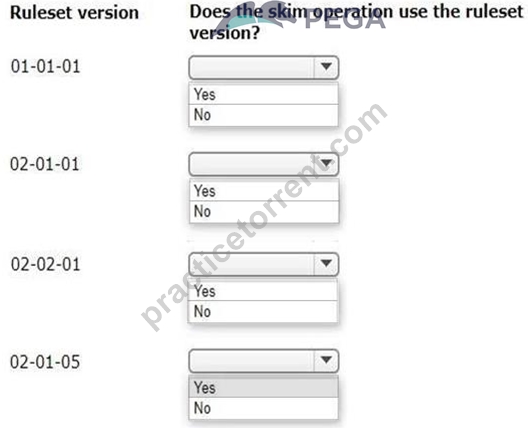
Answer:
Explanation:
NEW QUESTION # 103
Which two statements describe the role of the cache manifest in a mobile app? (Choose two.)
- A. Enables users to continue interacting with mobile apps while offline.
- B. Allows downloading of rules for offline use with a mobile app.
- C. Supports debugging efforts by providing a run-time view of the rules accessed by the app.
- D. Provides access to static resources such as HTML files, image files, or JS files.
Answer: B,D
Explanation:
The cache manifest in a mobile app facilitates the use of the app while offline by allowing the download of rules and static resources. This ensures that users can access the app's functionality and interface elements even when they do not have an internet connection. Reference: Pega Mobile Client Developer Guide.
NEW QUESTION # 104
......
Best way to practice test for Pegasystems PEGACPSSA23V1: https://www.practicetorrent.com/PEGACPSSA23V1-practice-exam-torrent.html
PEGACPSSA23V1 Dump Ready - Exam Questions and Answers: https://drive.google.com/open?id=1c6Fa8Iu2XjD6onmHIc7N-hP4XQXgkent