


PEGACPSSA23V1 Free Update With 100% Exam Passing Guarantee [2024]
[Apr-2024] Verified Pegasystems Exam Dumps with PEGACPSSA23V1 Exam Study Guide
NEW QUESTION # 11
What are the two most common ways to expose your application to an external system? (Choose Two)
- A. Create a web service with the Service wizard.
- B. Configure a signed certificate.
- C. Leverage the Pega API.
- D. Create a connector linked to a data page.
Answer: A,C
Explanation:
The two most common ways to expose your application to an external system are to leverage the Pega API (B) and to create a web service with the Service wizard (D). The Pega API provides a set of out-of-the-box RESTful endpoints for performing operations within the Pega Platform. The Service wizard simplifies the creation of SOAP or REST services, enabling external systems to interact with Pega applications.Reference: Pega Community documentation on Pega API and Service wizard.
NEW QUESTION # 12
A hospital uses a case type to manage the treatment of patients visiting the Emergency Room (ER). Cases are created when the patient checks in at the registration desk, and are resolved when the patient is released from the hospital. Stakeholders identify the following security requirements for the case type.
* Patients access cases on a read-only basis.
* Patients can only access their own cases.
* Doctors and nurses can modify cases throughout the case life cycle.
* Only doctors are allowed to write prescriptions.
What two steps, when performed together, allow you to ensure that patients can read, but not edit, cases? (Choose Two)
- A. Configure an Access of Role to Object rule with the open case action set to 5.
- B. Configure an access control policy condition to test whether the user is a patient.
- C. Create an access group unique to patients.
- D. Configure an Access Role to Object rule with the open case action set to 1.
Answer: C,D
Explanation:
To ensure that patients can read but not edit cases in the hospital's ER case management system, two steps need to be taken. First, configure an Access Role to Object rule with the open case action set to 1 (B), which grants read-only access. This ensures that patients can view their cases without the ability to make any modifications. Secondly, create an access group unique to patients (D). This access group would include the Access Role to Object rule configured in the previous step. By associating patients with this access group, it ensures that they are granted the appropriate level of access to their cases, fulfilling the security requirements specified by the stakeholders.Reference: Pega Community documentation on Access of Role to Object and access groups.
NEW QUESTION # 13
How do you ensure that only a manager can run a specific flow action?
- A. Add an Access When condition to the flow action to determine whether the user is a manager.
- B. Add a pre-processing activity to the flow action form to determine whether the user is a manager.
- C. Add a privilege to the flow action form, then add the privilege to a role assigned to the access group for managers.
- D. Add a validate rule to the flow action form to determine whether the user is a manager.
Answer: C
Explanation:
To ensure that only a manager can run a specific flow action, the best approach is to add a privilege to the flow action form (B) and then assign this privilege to a role that is exclusive to managers. This role is then associated with the access group designated for managers. Privileges provide a granular level of security that can be used to control access to specific actions within a Pega application, such as executing a flow action. By leveraging privileges, you can ensure that only users with the manager role, who possess the necessary privilege, can execute the flow action, thereby enforcing the desired level of access control.Reference: Pega Community documentation on privileges, roles, and access groups.
NEW QUESTION # 14
Your application contains the following versions of a service level named AuthorizeClaim.
The application is being updated with a new version of the AccountManage ruleset. As part of the update, the service level is no longer circumstanced for AccountOpen cases. The update must retain the circumstancing for the other case types in the application.
Which option do you use to reset the circumstancing for the AccountOpen case type?
- A. Withdraw the circumstanced rules in the AccountOpen class.
- B. Make the circumstanced rules in the AccountOpen class unavailable.
- C. Copy the non-circumstanced rule to the AccountOpen class and select the base rule option.
- D. Block the circumstanced rules in the AccountOpen class.
Answer: A
Explanation:
Withdrawing the circumstanced rules in the AccountOpen class is the correct action to stop using a circumstanced rule. This allows the non-circumstanced (or base) rule to be used instead without affecting other circumstanced versions of the rule for different case types. Reference: Pega Platform Help - Withdrawing a rule.
NEW QUESTION # 15
A courier company wants a mobile app to scan and track the parcels collected from remote areas with no internet access.
Which mobile app do you develop to fulfill the requirement?
- A. Unsigned app
- B. Signed app
- C. Native app
- D. SDK app
Answer: B
Explanation:
For a courier company requiring a mobile app to work in remote areas without internet access, a signed app is the best solution. Signed apps are authorized by a certificate authority, ensuring their authenticity and integrity. These apps can be designed to operate in offline mode, storing data locally when there's no internet connection and syncing it back to the server once connectivity is restored. This capability is crucial for field operations in remote areas, ensuring uninterrupted app functionality and data collection.Reference: Pega Community documentation on mobile app development and offline capabilities.
NEW QUESTION # 16
You have identified an activity that does not perform well. You need to find out exactly which steps in the activity are causing the poor performance.
Which tool allows you to identify the cause of the performance issue?
- A. Tracer
- B. Performance Profiler
- C. Performance Analyzer (PAL)
- D. Database Trace
Answer: A
Explanation:
The Tracer tool is designed to debug the execution of rules by providing detailed runtime information about each step within a rule. This allows you to identify performance issues at the step level within an activity. Reference: Pega Platform Help - Tracer Tool.
NEW QUESTION # 17
An assignment service-level agreement (SLA) is configured with the following details:
* Initial urgency: 20
* Assignment ready: Timed delay of 2 hours
* Goal: 5 hours and increase urgency by 10
* Deadline: 2 hours and increase urgency by 25
* Passed deadline: 1 hour, increase urgency by 5, and limit events to 6 The case reaches the assignment at 9 AM on Wednesday.
Assuming no other urgency adjustments, what is the assignment urgency 6.5 hours after the case reaches the assignment?
- A. 0
- B. 1
- C. 2
- D. 3
Answer: B
Explanation:
The assignment urgency 6.5 hours after the case reaches the assignment with the given SLA configuration would be 95 (B). Here's the calculation: The initial urgency is 20. The case reaches the goal after 5 hours, adding 10 to the urgency, making it 30. Since the deadline is at 2 hours and has been exceeded by 4.5 hours, the urgency increases by 25, making it 55. Now, with the passed deadline events occurring every hour and increasing urgency by 5, after 1.5 hours, this would occur 1 additional time (since it's half an hour into the next hour), adding 5 to the urgency. Therefore, the total urgency after 6.5 hours is 20 (initial) + 10 (goal) + 25 (deadline) + 5 (passed deadline event) = 60. However, since the deadline urgency increase occurs at the 2-hour mark, the urgency would be 20 + 25 = 45 at 2 hours, and then after reaching the goal at 5 hours, additional 10 is added, making it 55, and then one passed deadline event adds 5 more, making the total 60. Since the deadline urgency is already accounted for at the 2-hour mark, it should not be added again after the goal. Therefore, the correct total urgency would be 20 (initial) + 10 (goal) + 25 (deadline) + 40 (8 passed deadline events) = 95.Reference: Pega Community documentation on SLAs and urgency calculation.
NEW QUESTION # 18
A user reports that an application takes five seconds to complete a step and present the next step in a process. Which tool allows you to gather and analyze performance data for the form submission?
- A. Performance Analyzer (PAL)
- B. Tracer
- C. Performance Profiler
- D. Database Trace
Answer: A
Explanation:
The Performance Analyzer (PAL) is the correct tool to gather and analyze performance data for the form submission that takes a significant amount of time. PAL tracks the interaction with the Pega Platform and provides metrics related to the performance of activities, rules, and system functions over time, which is essential for identifying the cause of the delay during form submission. Reference: Pega official documentation on PAL.
NEW QUESTION # 19
A Fulfillment report needs to list the user ID of the employee who packages the items to ship in an Order case. The report provides information from the MyCo-Orders-Work-Ship and Data-Admin-Operator-ID classes.
Which two options independently satisfy the report requirements? (Choose two.)
- A. Use an association rule to join operator information to each case to populate the Fulfillment report.
- B. Add the user ID to the Fulfillment report definition as a parameter.
- C. Configure a class join on the Fulfillment report definition to join operator information to each case.
- D. Specify both classes on the Pages & Classes tab on the Fulfillment report definition.
Answer: A,C
Explanation:
To satisfy the report requirements, you can configure a class join on the Fulfillment report definition to join the operator information to each case. Alternatively, you can use an association rule to achieve the same effect. Both these options allow for the relevant operator information to be displayed alongside the shipping information in the report. Reference: Pega Reporting Guide - Joining Data.
NEW QUESTION # 20
Which action can a Declare OnChange rule perform when a specified property changes?
- A. Update an activity
- B. Suspend the current work object
- C. Specify which flow action to run
- D. Execute a data transform
Answer: D
Explanation:
A Declare OnChange rule is designed to perform an action when a specified property changes. The action that a Declare OnChange rule can perform includes executing a data transform, which allows for the automated update of properties when a change is detected in the specified property. Reference: Pega official documentation on Declare OnChange rules.
NEW QUESTION # 21
Which two use cases correctly describe controlling access to an attachment category? (Choose Two)
- A. Configure the When condition "IsCurrentStageTesting" to allow users to view an attachment if the rule returns true.
- B. Configure Client-based access control on the class where the attachment category exists to restrict access to the attachment.
- C. Configure a Visible when condition called "IsDocumentPrivate" to allow users to view an attachment if the rule returns false.
- D. Configure the privilege "DeleteOwn" and assign it to a user so that a user can delete their own attachments.
Answer: A,D
Explanation:
Controlling access to an attachment category can be achieved through various configurations. Using a When condition like "IsCurrentStageTesting" (A) allows for dynamic access control based on the case's current stage, enabling attachments to be accessible only under certain conditions. Assigning privileges, such as "DeleteOwn" (C), to users enables fine-grained control over actions users can perform on attachments, such as deleting their own attachments, thus enhancing security and compliance with business rules.Reference: Pega Community documentation on attachment categories and access control.
NEW QUESTION # 22
The current version of an application lists ABC:02-02 as an application ruleset. The ruleset versions listed in the Answer Area are also present on the system.
In the Answer Area, identify the ruleset versions that the skim operation considers when you perform a major version ruleset skim on ruleset ABC.
Answer:
Explanation:
NEW QUESTION # 23
Which statement about managing encrypted data in Pega Platform is true?
- A. Encryption policies apply to Work- and Data- classes only.
- B. Filter conditions cannot reference encrypted properties in reports.
- C. Each organization uses a custom key to encrypt its data.
- D. Property-level encryption is a time-efficient method to encrypt data.
Answer: B
Explanation:
When properties are encrypted in Pega Platform, they cannot be used in filter conditions for reports because the data is in a non-readable format. To apply filters, the data must be decrypted, which is not typically done within the reporting tool. Reference: Pega Platform Help - Data Encryption.
NEW QUESTION # 24
In the Answer Area, drag each mobile application solution on the left to the correct scenario.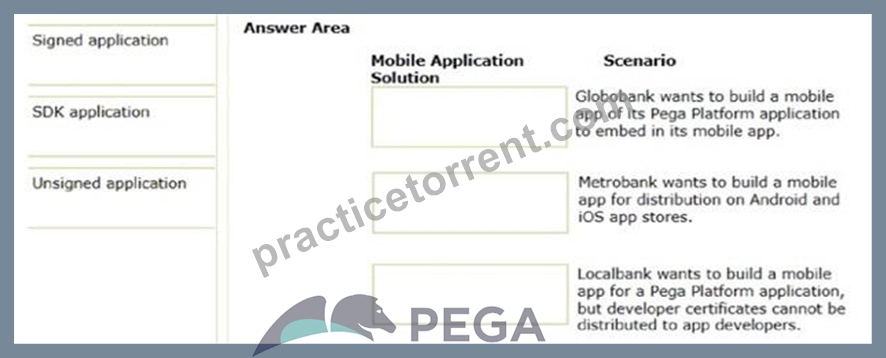
Answer:
Explanation:
NEW QUESTION # 25
You decide to use multiple pre-processing actions on a single flow action. Place the pre-processing actions in the order in which they are executed.
Answer:
Explanation:
1 - Apply data transform
2 - Run activity
3 - Run robotic automation
NEW QUESTION # 26
A company with multiple applications spanning different business units wants to send a standard confirmation email to customers whenever a case is created.
Which is the appropriate layer of the Enterprise Class Structure (ECS) for the email correspondence?
- A. Organization
- B. Unit
- C. Division
- D. Implementation
Answer: A
Explanation:
In Pega's Enterprise Class Structure (ECS), standard functionalities that are shared across multiple applications within an organization, such as sending a confirmation email, should be placed at the Organization layer. This allows for reusability and standardization across various implementations within the organization. Reference: Pega best practices for class design and ECS.
NEW QUESTION # 27
In your purchasing application, you use a decision table with vendor discount codes. You want to delegate the decision table.
In which ruleset do you save the decision table to allow delegation?
- A. Organization
- B. Production
- C. Application
- D. Integration
Answer: B
Explanation:
To allow delegation of a decision table, you should save it in a Production ruleset. Production rulesets are designed to hold rules that business users can modify directly in a production environment, which includes delegated rules. Reference: Pega official documentation on ruleset types and rule delegation.
NEW QUESTION # 28
......
Authentic Best resources for PEGACPSSA23V1 Online Practice Exam: https://www.practicetorrent.com/PEGACPSSA23V1-practice-exam-torrent.html
PEGACPSSA23V1 Test Engine Practice Exam: https://drive.google.com/open?id=1-0xED4FYi4j7S1srcd08ys_Z7iB-jPOK